Latest
Your Baby Is Not Crying Randomly. Learning the Patterns Behind Infant Crying
Few sounds can make a caregiver feel as helpless as a baby's cry.
You try feeding.
You check the diaper.
You walk around the room.
You rock.
You sing.
And somehow the crying continues.
It is easy to conclude that the baby is simply being difficult or that you are missing something obvious.
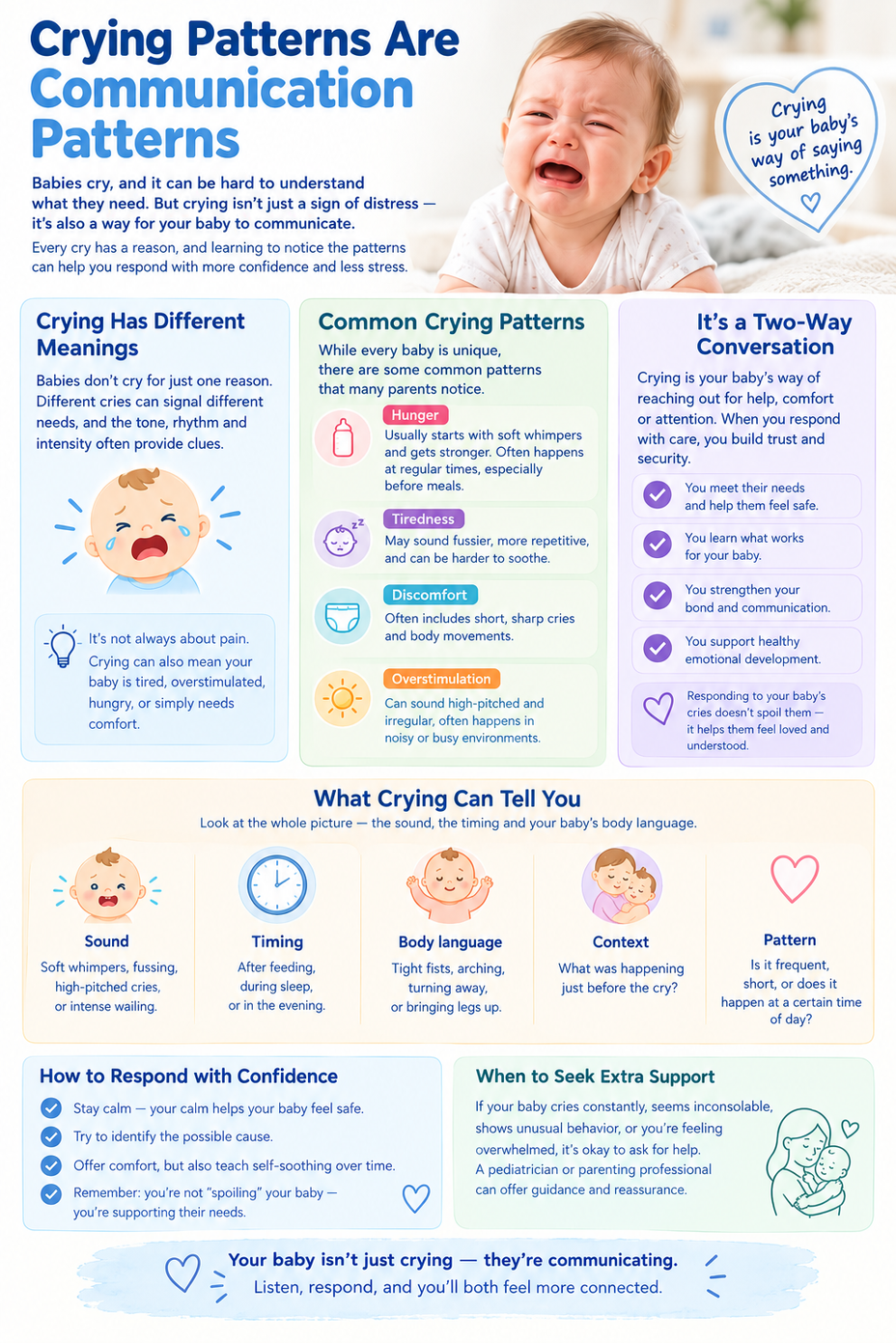
But crying is not random noise.
For infants, it is one of their primary communication systems.
The challenge is that they do not come with subtitles.
Crying Is More Than One Message
A baby cannot say:
I am hungry.
I am tired.
That noise is too loud.
I need a break.
I am uncomfortable.
I want you close.
Instead, many of these experiences may come out through the same basic behavior.
Crying.
This is why trying to create one universal meaning for crying rarely works.
The useful information is often hidden in the pattern surrounding the cry.
Look at What Happens Before the Cry
Context can tell you more than volume.
Consider what happened in the minutes before the baby started crying.
Was it close to feeding time?
Had the baby been awake for a long time?
Was there a lot of noise or activity?
Did someone just put the baby down?
Was there a diaper change?
Did the crying begin suddenly or gradually?
These details can help caregivers recognize recurring patterns.
Over time, many parents become surprisingly good at identifying what different cries tend to mean for their own baby.
Not because every cry is scientifically unique.
Because they have learned the context.
Why Crying Changes Throughout the Day
Infant behavior is influenced by sleep, feeding, stimulation, discomfort, and developing regulation.
A baby who is calm in the morning may become much harder to settle later in the day.
This does not necessarily mean something has gone wrong.
Sometimes the accumulated effects of being awake, hungry, tired, and overstimulated simply become harder for the baby to manage.
That is why a crying pattern can be more useful than an isolated crying episode.
The Parent's Emotional Response Matters Too
Crying activates adults.
A baby's distress can trigger urgency, frustration, fear, and even guilt.
The internal dialogue can become:
Why can't I stop this?
What am I doing wrong?
Why is everyone else's baby easier?
Those thoughts are understandable.
But they can make observation harder.
Instead of immediately treating every cry as an emergency, caregivers can pause when circumstances allow and look for the surrounding pattern.
What happened before it started?
What usually helps?
How long does it last?
Does anything consistently make it worse?
Pattern recognition turns chaos into information.
Not Every Cry Needs to Be Solved Immediately
This can be one of the hardest lessons.
Sometimes a baby continues crying even after a caregiver has checked the obvious needs.
That does not automatically mean the caregiver has failed.
Babies can have difficulty settling even when they are fed, dry, comfortable, and safe.
The goal is not always to eliminate crying instantly.
Sometimes the goal is simply to stay present while the baby works through a difficult state.
When Crying Is Different From the Usual Pattern
Patterns are also useful because they make unusual changes easier to notice.
A sudden change in crying, especially when combined with signs such as difficulty breathing, unusual sleepiness, persistent vomiting, fever in a young infant, poor feeding, or other concerning symptoms, deserves appropriate medical attention.
The point is not to diagnose from a cry.
It is to recognize when the overall picture has changed.
A Better Question
Instead of asking:
How do I make my baby stop crying?
Try asking:
What changed before the crying started?
That question encourages observation rather than panic.
You may discover that the same sequence happens repeatedly.
Long wake period.
Increasing fussiness.
Crying.
Difficulty settling.
Or feeding.
Brief calm.
Crying again.
Those patterns can become valuable clues about what the baby is experiencing.
The Quiet Reframe
Crying is not a parenting score.
A baby who cries frequently is not proof of a bad caregiver.
And a baby who rarely cries is not proof of perfect parenting.
Crying is communication from a person who has very few communication tools.
The more caregivers learn to see the pattern rather than only hear the noise, the less mysterious it becomes.
The cry may still be exhausting.
It may still be frustrating.
But it becomes something that can be observed, understood, and responded to rather than something that automatically means something has gone wrong.
#Parenting #BabyCrying #InfantCommunication #newborncare #BabyDevelopment #ResponsiveParenting #ParentingTips #InfantCare