ParentingTips

Create a new post for topic
Join the Conversation on
3 people
0 stories
3 posts
Explore Our Newsletters
What's New in
All
Stories
Posts
Videos
Latest
Trending
Post
See full photo

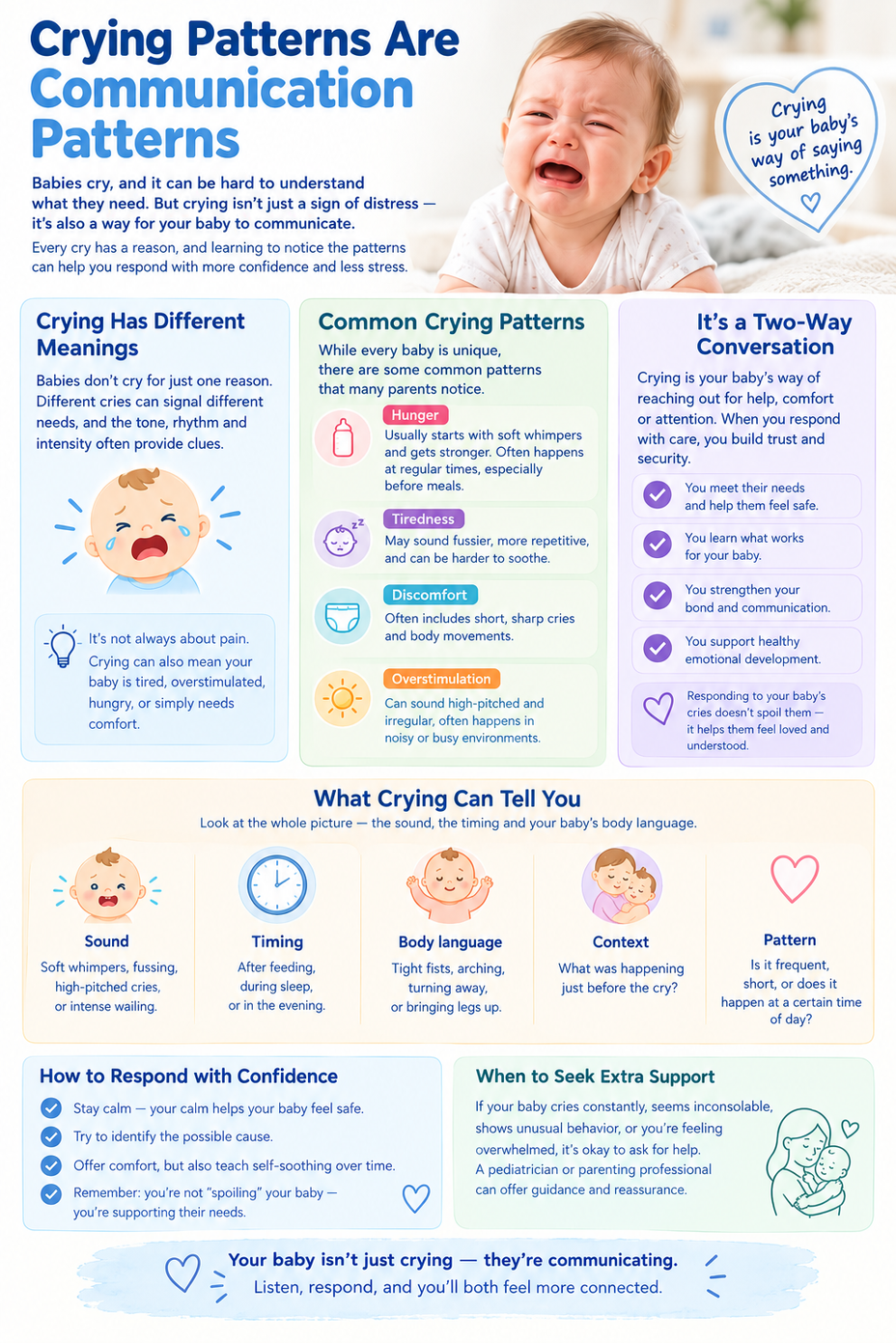
Your Baby Is Not Crying Randomly. Learning the Patterns Behind Infant Crying

Few sounds can make a caregiver feel as helpless as a baby's cry.

You try feeding.

You check the diaper.

You walk around the room.

You rock.

You sing.

And somehow the crying continues.

It is easy to conclude that the baby is simply being difficult or that you are missing something obvious.

But crying is not random noise.

For infants, it is one of their primary communication systems.

The challenge is that they do not come with subtitles.

Crying Is More Than One Message

A baby cannot say:

I am hungry.

I am tired.

That noise is too loud.

I need a break.

I am uncomfortable.

I want you close.

Instead, many of these experiences may come out through the same basic behavior.

Crying.

This is why trying to create one universal meaning for crying rarely works.

The useful information is often hidden in the pattern surrounding the cry.

Look at What Happens Before the Cry

Context can tell you more than volume.

Consider what happened in the minutes before the baby started crying.

Was it close to feeding time?

Had the baby been awake for a long time?

Was there a lot of noise or activity?

Did someone just put the baby down?

Was there a diaper change?

Did the crying begin suddenly or gradually?

These details can help caregivers recognize recurring patterns.

Over time, many parents become surprisingly good at identifying what different cries tend to mean for their own baby.

Not because every cry is scientifically unique.

Because they have learned the context.

Why Crying Changes Throughout the Day

Infant behavior is influenced by sleep, feeding, stimulation, discomfort, and developing regulation.

A baby who is calm in the morning may become much harder to settle later in the day.

This does not necessarily mean something has gone wrong.

Sometimes the accumulated effects of being awake, hungry, tired, and overstimulated simply become harder for the baby to manage.

That is why a crying pattern can be more useful than an isolated crying episode.

The Parent's Emotional Response Matters Too

Crying activates adults.

A baby's distress can trigger urgency, frustration, fear, and even guilt.

The internal dialogue can become:

Why can't I stop this?

What am I doing wrong?

Why is everyone else's baby easier?

Those thoughts are understandable.

But they can make observation harder.

Instead of immediately treating every cry as an emergency, caregivers can pause when circumstances allow and look for the surrounding pattern.

What happened before it started?

What usually helps?

How long does it last?

Does anything consistently make it worse?

Pattern recognition turns chaos into information.

Not Every Cry Needs to Be Solved Immediately

This can be one of the hardest lessons.

Sometimes a baby continues crying even after a caregiver has checked the obvious needs.

That does not automatically mean the caregiver has failed.

Babies can have difficulty settling even when they are fed, dry, comfortable, and safe.

The goal is not always to eliminate crying instantly.

Sometimes the goal is simply to stay present while the baby works through a difficult state.

When Crying Is Different From the Usual Pattern

Patterns are also useful because they make unusual changes easier to notice.

A sudden change in crying, especially when combined with signs such as difficulty breathing, unusual sleepiness, persistent vomiting, fever in a young infant, poor feeding, or other concerning symptoms, deserves appropriate medical attention.

The point is not to diagnose from a cry.

It is to recognize when the overall picture has changed.

A Better Question

Instead of asking:

How do I make my baby stop crying?

Try asking:

What changed before the crying started?

That question encourages observation rather than panic.

You may discover that the same sequence happens repeatedly.

Long wake period.

Increasing fussiness.

Crying.

Difficulty settling.

Or feeding.

Brief calm.

Crying again.

Those patterns can become valuable clues about what the baby is experiencing.

The Quiet Reframe

Crying is not a parenting score.

A baby who cries frequently is not proof of a bad caregiver.

And a baby who rarely cries is not proof of perfect parenting.

Crying is communication from a person who has very few communication tools.

The more caregivers learn to see the pattern rather than only hear the noise, the less mysterious it becomes.

The cry may still be exhausting.

It may still be frustrating.

But it becomes something that can be observed, understood, and responded to rather than something that automatically means something has gone wrong.

#Parenting #BabyCrying #InfantCommunication #newborncare #BabyDevelopment #ResponsiveParenting #ParentingTips #InfantCare

Post
See full photo

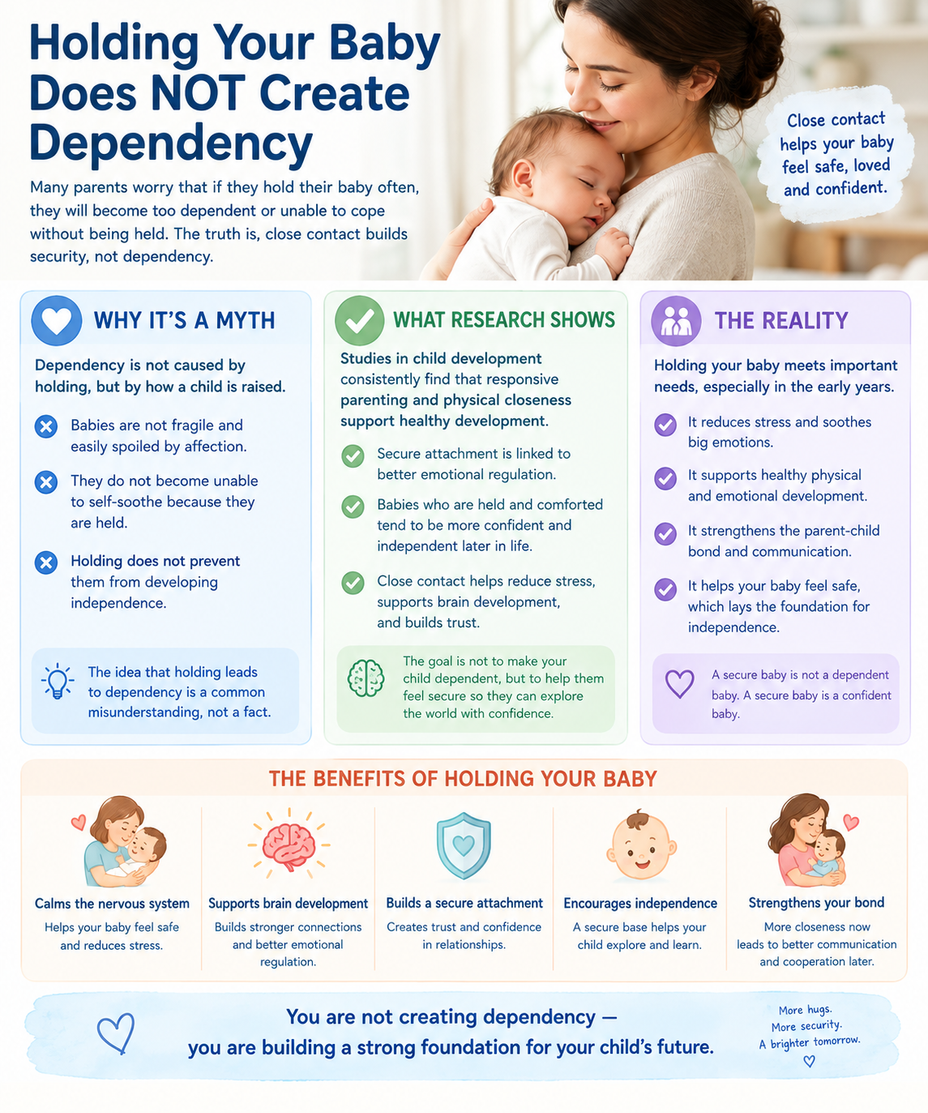
Holding Your Baby Does Not Create Dependency. It Builds a Sense of Safety

There is a piece of parenting advice that has survived for generations:

Do not hold the baby too much.

Otherwise, they will get used to it.

The fear is understandable. Parents are often told that babies need to learn independence early, as if every extra cuddle is teaching them to demand more attention later.

But infant development does not work like a simple reward system.

A baby does not think, I was held today, so now I must be held forever.

For a young infant, being held is part of how they experience safety, connection, and regulation.

Babies Are Not Manipulating You

A newborn has very limited ways to communicate what they need.

They cannot walk toward a caregiver.

They cannot explain that they are overwhelmed.

They cannot say that they are tired, uncomfortable, lonely, or simply looking for reassurance.

So they use the tools available to them.

Crying.

Movement.

Eye contact.

And physical contact.

When a caregiver picks up a baby, the baby experiences changes in breathing, movement, warmth, sound, and physical support.

That is not creating a bad habit.

It is providing information about the world.

Someone is here.

I am safe.

My needs can be responded to.

Why Being Held Can Feel Like a Necessity

Babies are still developing their ability to regulate their own emotional and physical states.

An adult can calm down by leaving a stressful room, taking a shower, listening to music, or talking to someone.

A newborn has none of those options.

Their regulation system is much less developed.

Physical closeness can therefore become one of the simplest ways to help them settle.

This is why a baby may become calm almost immediately after being picked up.

It is not necessarily because they have learned that crying gets rewarded.

It can simply be because the nervous system has received the support it was looking for.

Comfort Is Not the Same as Dependency

This distinction matters.

A baby needing a caregiver is not the same thing as a child being unable to develop independence.

In fact, independence develops gradually from a foundation of security.

As children mature, they gain more ways to regulate themselves.

They learn to move away and return.

They explore their surroundings.

They develop language.

They discover ways to handle frustration.

The goal is not to force independence before the child has the developmental tools for it.

The goal is to give them enough security to eventually explore without constant physical reassurance.

Why Parents Feel Guilty About Holding

Modern parenting can make almost everything feel like a habit that needs to be managed.

Too much feeding.

Too much rocking.

Too much holding.

Too much comforting.

Parents can start worrying that every response today will create a permanent behavior tomorrow.

But infants are not tiny adults forming long term strategies.

Their needs change rapidly because their brains and bodies are changing rapidly.

What a newborn needs at two months may look very different from what that same child needs at two years.

There Is Still Room for Boundaries

Recognizing the value of physical comfort does not mean parents must hold their baby every moment.

Caregivers also need sleep, food, personal space, and practical support.

Putting a baby down safely while taking a break is not emotional neglect.

Asking someone else to hold the baby is not abandonment.

Healthy caregiving includes both connection and realistic limits.

The important point is that responding to a baby's need for comfort does not automatically create unhealthy dependence.

A More Useful Question

Instead of asking:

Will holding my baby too much make them dependent?

Try asking:

What is my baby communicating through this need for closeness?

Sometimes the answer is tiredness.

Sometimes hunger.

Sometimes overstimulation.

Sometimes discomfort.

And sometimes the baby simply wants contact.

Not every need requires a complicated explanation.

The Quiet Reframe

Babies do not become independent because adults teach them not to need people.

They become increasingly independent as their abilities grow.

Holding a baby is not a failure to teach independence.

For many babies, it is simply one of the earliest experiences of being cared for.

And eventually, the same baby who once needed to be carried everywhere will be the child running away to explore the room.

The independence was never missing.

It was still developing.

#Parenting #BabyDevelopment #InfantCare #newborncare #ResponsiveParenting #ParentingTips #BabyBonding #ChildDevelopment

Most common user reactions 1 reaction