


 Latest
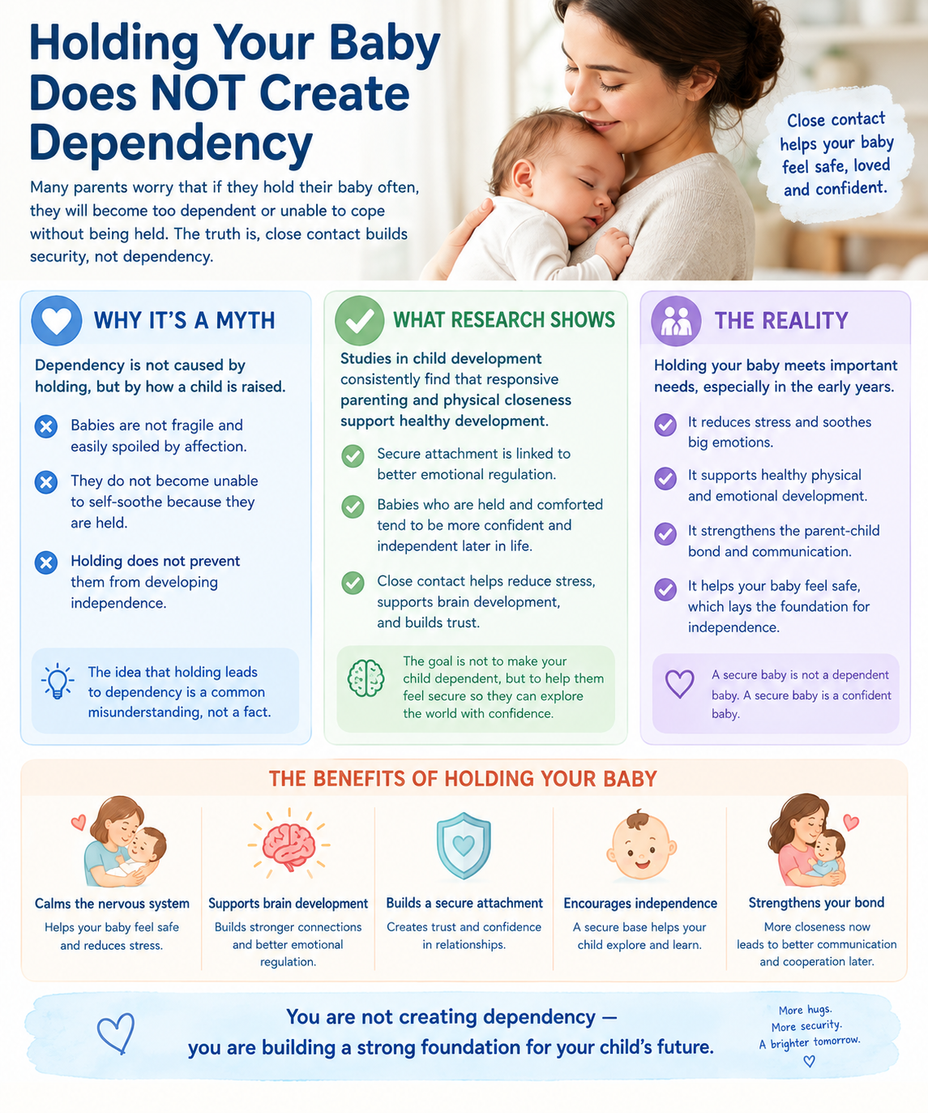
Holding Your Baby Does Not Create Dependency. It Builds a Sense of Safety
There is a piece of parenting advice that has survived for generations:
Do not hold the baby too much.
Otherwise, they will get used to it.
The fear is understandable. Parents are often told that babies need to learn independence early, as if every extra cuddle is teaching them to demand more attention later.
But infant development does not work like a simple reward system.
A baby does not think, I was held today, so now I must be held forever.
For a young infant, being held is part of how they experience safety, connection, and regulation.
Babies Are Not Manipulating You
A newborn has very limited ways to communicate what they need.
They cannot walk toward a caregiver.
They cannot explain that they are overwhelmed.
They cannot say that they are tired, uncomfortable, lonely, or simply looking for reassurance.
So they use the tools available to them.
Crying.
Movement.
Eye contact.
And physical contact.
When a caregiver picks up a baby, the baby experiences changes in breathing, movement, warmth, sound, and physical support.
That is not creating a bad habit.
It is providing information about the world.
Someone is here.
I am safe.
My needs can be responded to.
Why Being Held Can Feel Like a Necessity
Babies are still developing their ability to regulate their own emotional and physical states.
An adult can calm down by leaving a stressful room, taking a shower, listening to music, or talking to someone.
A newborn has none of those options.
Their regulation system is much less developed.
Physical closeness can therefore become one of the simplest ways to help them settle.
This is why a baby may become calm almost immediately after being picked up.
It is not necessarily because they have learned that crying gets rewarded.
It can simply be because the nervous system has received the support it was looking for.
Comfort Is Not the Same as Dependency
This distinction matters.
A baby needing a caregiver is not the same thing as a child being unable to develop independence.
In fact, independence develops gradually from a foundation of security.
As children mature, they gain more ways to regulate themselves.
They learn to move away and return.
They explore their surroundings.
They develop language.
They discover ways to handle frustration.
The goal is not to force independence before the child has the developmental tools for it.
The goal is to give them enough security to eventually explore without constant physical reassurance.
Why Parents Feel Guilty About Holding
Modern parenting can make almost everything feel like a habit that needs to be managed.
Too much feeding.
Too much rocking.
Too much holding.
Too much comforting.
Parents can start worrying that every response today will create a permanent behavior tomorrow.
But infants are not tiny adults forming long term strategies.
Their needs change rapidly because their brains and bodies are changing rapidly.
What a newborn needs at two months may look very different from what that same child needs at two years.
There Is Still Room for Boundaries
Recognizing the value of physical comfort does not mean parents must hold their baby every moment.
Caregivers also need sleep, food, personal space, and practical support.
Putting a baby down safely while taking a break is not emotional neglect.
Asking someone else to hold the baby is not abandonment.
Healthy caregiving includes both connection and realistic limits.
The important point is that responding to a baby's need for comfort does not automatically create unhealthy dependence.
A More Useful Question
Instead of asking:
Will holding my baby too much make them dependent?
Try asking:
What is my baby communicating through this need for closeness?
Sometimes the answer is tiredness.
Sometimes hunger.
Sometimes overstimulation.
Sometimes discomfort.
And sometimes the baby simply wants contact.
Not every need requires a complicated explanation.
The Quiet Reframe
Babies do not become independent because adults teach them not to need people.
They become increasingly independent as their abilities grow.
Holding a baby is not a failure to teach independence.
For many babies, it is simply one of the earliest experiences of being cared for.
And eventually, the same baby who once needed to be carried everywhere will be the child running away to explore the room.
The independence was never missing.
It was still developing.
Recognizing the value of physical comfort does not mean parents must hold their baby every moment.
Caregivers also need sleep, food, personal space, and practical support.
Putting a baby down safely while taking a break is not emotional neglect.
Asking someone else to hold the baby is not abandonment.
Healthy caregiving includes both connection and realistic limits.
The important point is that responding to a baby's need for comfort does not automatically create unhealthy dependence.
A More Useful Question
Instead of asking:
Will holding my baby too much make them dependent?
Try asking:
What is my baby communicating through this need for closeness?
Sometimes the answer is tiredness.
Sometimes hunger.
Sometimes overstimulation.
Sometimes discomfort.
And sometimes the baby simply wants contact.
Not every need requires a complicated explanation.
The Quiet Reframe
Babies do not become independent because adults teach them not to need people.
They become increasingly independent as their abilities grow.
Holding a baby is not a failure to teach independence.
For many babies, it is simply one of the earliest experiences of being cared for.
And eventually, the same baby who once needed to be carried everywhere will be the child running away to explore the room.
The independence was never missing.
It was still developing.
#Parenting #BabyDevelopment #InfantCare #newborncare #ResponsiveParenting #ParentingTips #BabyBonding #ChildDevelopment
 1 reaction


