Fear doesn’t show up politely.
It doesn’t knock, wait, and ask if this is a good time. It floods, it tightens, it whispers lies that feel like truth. And for a long time, the instinct has been simple: get rid of it. Avoid it. Numb it. Run from it.
But here’s the shift—one that changes everything:
Fear isn’t always the thing holding you back. Sometimes, it’s the thing pointing you forward.
Fear Kept You Alive — But It Was Never Meant to Keep You Small
Fear is not a character flaw. It’s biology.
Deep in the brain, the amygdala is wired to detect danger and activate survival responses (LeDoux, 2012). That response—the racing heart, the tension, the urge to escape—has one job: protect you.
And for many, especially those who have lived through trauma, addiction, or unstable environments, fear has been working overtime for years.
It learned quickly:
*What was unsafe
*What hurt
*What needed to be avoided
That fear? It served a purpose.
But what protected you then may be restricting you now.
When Fear Gets Misunderstood
Not all fear means danger.
Some fear is rooted in past experiences—what research on adverse childhood experiences (ACEs) shows is that early trauma can sensitize the nervous system to perceive threat where there isn’t one anymore (Felitti et al., 1998).
So now fear shows up when:
*You try to trust someone
*You speak your truth
*You step outside your comfort zone
*You choose recovery over old patterns
And it feels the same as danger.
But it’s not.
It’s unfamiliarity.
And unfamiliarity can feel just as intense as threat when your system has been conditioned to expect harm.
Fear and the Cycle of Avoidance
Let’s be direct—avoidance feels good in the moment.
It lowers anxiety. It gives relief. It creates the illusion of control.
That’s why it’s so addictive.
In fact, the self-medication hypothesis explains how substances and behaviors are often used to regulate overwhelming emotions like fear (Khantzian, 1997).
But here’s the cost:
*The fear doesn’t go away
*It gets stronger
*Your world gets smaller
Avoidance teaches your brain: “This fear is dangerous. Escape is necessary.”
And the cycle tightens.
The Truth Most People Don’t Want to Hear
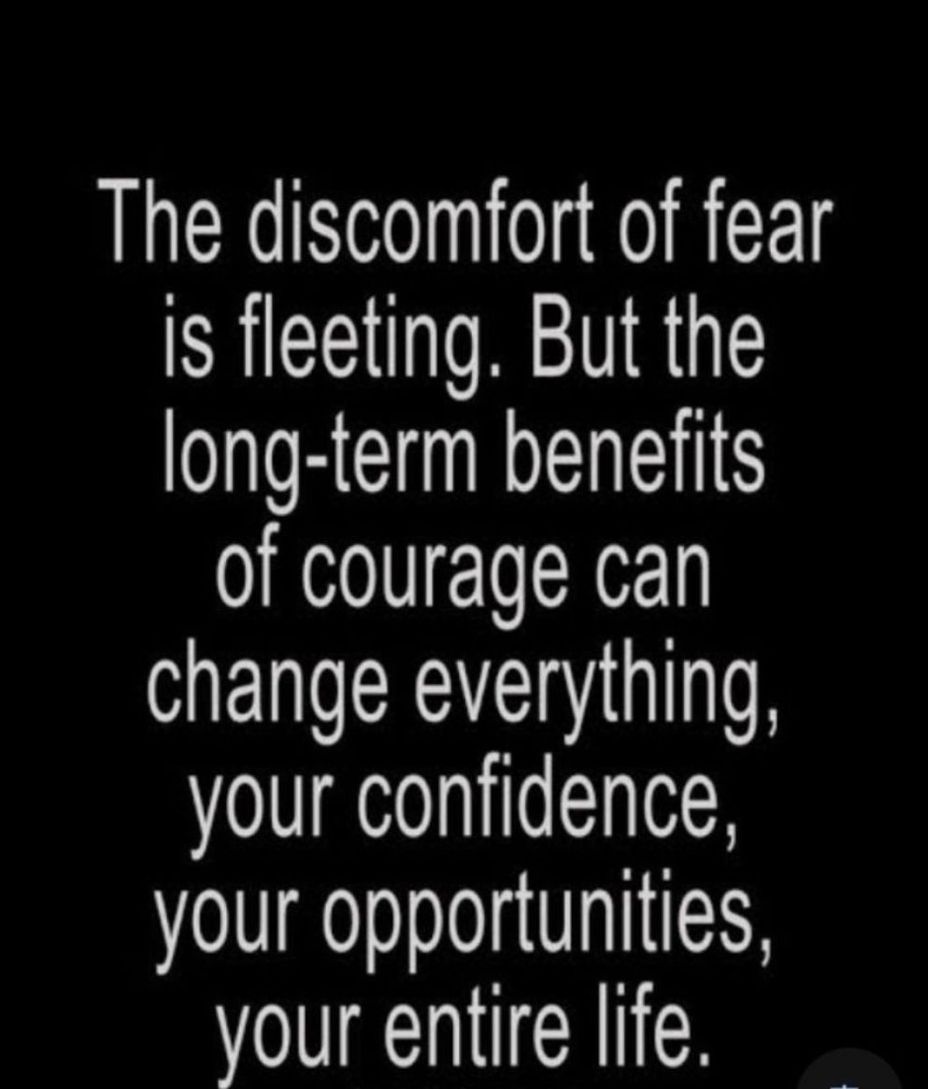
Fear doesn’t shrink when you run from it.
It shrinks when you face it.
Not all at once. Not recklessly. But intentionally.
Exposure-based approaches in mental health show that gradually facing what you fear actually retrains the brain to reduce that fear response over time (Craske et al., 2014).
This is how healing works:
*You stay
*You feel
*You don’t escape
*And your brain learns: “I survived this.”
That’s how power is rebuilt.
Fear Is Often the Edge of Growth
There’s a type of fear that doesn’t come from danger—it comes from change.
You’ll recognize it when:
*You’re about to set a boundary you’ve never set before
*You’re walking away from something familiar but harmful
*You’re choosing yourself for the first time
*You’re stepping into a version of you that feels unfamiliar
That fear will say:
*“You’re going to fail”
*“You’re not ready”
*“Go back to what you know”
But what it’s really saying is:
“You’re crossing into something new.”
And new feels unsafe… until it doesn’t.
Building Capacity Instead of Running
Healing isn’t about eliminating fear—it’s about expanding your ability to handle it.
This is what’s called widening your window of tolerance (Siegel, 1999).
Every time you:
*Sit with discomfort
*Regulate instead of react
*Stay instead of escape
*You are literally rewiring your nervous system.
You’re teaching your body: “I can handle this.”
And over time, what once overwhelmed you… doesn’t.
A Different Way to Respond to Fear
Instead of asking:
“How do I get rid of this?”
Start asking:
“What is this trying to show me?”
“Is this danger—or is this growth?”
“What happens if I don’t run this time?”
Then take one step.
Not ten. Not perfect. Just one.
The Reality No One Talks About
Fear will show up in recovery.
It will show up in healing.
It will show up when you start becoming someone you’ve never been before.
That doesn’t mean you’re doing it wrong.
It usually means you’re doing it right.
Closing: Rise Above Your Norm
You don’t rise above your norm by staying comfortable.
You rise by challenging the very patterns that once felt like survival.
Fear was part of your survival story.
But it doesn’t have to be the author of your future.
You can feel it—and still move forward.
You can hear it—and not obey it.
You can carry it—and not let it control you.
That’s the shift.
That’s the work.
That’s how you rise.
BigmommaJ
#Fear #MentalHealth #RiseAboveYourNorm


 Latest


 4 reactions •
1 comment
4 reactions •
1 comment