Complex Post-traumatic Stress Disorder

Create a new post for topic
Join the Conversation on
Complex Post-traumatic Stress Disorder
73.8K people
0 stories
17.7K posts
About Complex Post-traumatic Stress Disorder Show topic details
Explore Our Newsletters
What's New in Complex Post-traumatic Stress Disorder
All
Stories
Posts
Videos
Latest
Trending
Post
See full photo

Questions about my DID… and the answers I sometimes wish I could give.

**Do you have a lot of parts?**

Yes.

**How many?**

Honestly, I don’t know exactly. And at some point, the number stopped being the most important thing.

What matters more is:

Who is here right now?

What does this part need?

And who is actually handling the taxes this year?

**Do all the parts listen to each other?**

No.

Because every part has their own experiences, feelings, and needs.

There is no inner boss with a megaphone saying:

“Alright, everyone does exactly the same thing now.”

Would be nice sometimes.

**Are there rules everyone has to follow?**

We try.

But imagine different parts of one person trying to organize everyday life together. With different opinions, fears, and needs.

Just in the same body.

And nobody volunteers for the cleaning schedule.

**Can handwriting change?**

Yes, sometimes.

My grocery list can look like several parts tried to leave a secret message at the same time.

Who did it?

No idea.

Everyone looks innocent.

**Do you have different music tastes?**

Absolutely.

Our playlist sometimes feels like someone accidentally connected a stranger’s phone.

Calm music one moment.

Then suddenly techno.

No transition.

No explanation.

**Do you have different preferences when it comes to food?**

Yes.

The fridge can become a little surprise box.

“Who bought this?”

“Why do we have five of these?”

“And why does this have a name written on it?”

The closet can be similar.

What feels perfect for one part can feel like a costume for another.

Sometimes it is less a closet and more a diplomatic negotiation table.

**Can people notice from the outside when someone switches?**

Sometimes.

Sometimes not.

Voice, body language, facial expressions, or behavior can change.

And then someone might think:

“Why is this person suddenly acting so differently?”

Short answer:

Shift change.

But not every DID system looks the same, and not every switch is visible.

**Do all the parts have the same age?**

No.

In a DID system, parts can have different inner ages.

Some are children.

Some are teenagers.

Some are adults.

The ID shows one number.

But different parts may have their own inner ages.

**Do you forget plans?**

Sometimes.

Not because we don’t care.

But because sometimes the part who agreed to something wasn’t the one who was present later.

Our calendar is less of a law and more of an optimistic suggestion.

**What about friendships?**

Sometimes they can be complicated.

Not every part likes the same people.

Some feel completely comfortable around certain people, while another thinks:

“Do we really have to?”

Friendship for us can mean bringing many different feelings together.

**Do you have different ways of speaking?**

Yes.

Sometimes it sounds like a job interview.

Sometimes like an annoyed teenager who just slammed the door.

People close to us have learned:

Don’t overanalyze it.

Just get to know us.

**Are there different fears?**

Yes.

Some parts are afraid of conflict.

Some of completely different things.

And sometimes a simple dentist appointment becomes a full internal production.

**Do you always know what the others have experienced?**

No.

Sometimes a memory feels like a message from an unknown number:

“By the way, that happened.”

And you sit there thinking:

“Okay… and who exactly was involved?”

The same can happen with things we have learned.

One part remembers every math formula.

Another wonders:

“Since when can we do that?”

**Are there parts that are difficult?**

This question comes up often.

Yes, sometimes there are parts that are difficult to live with.

Sometimes difficult for my bank account too.

But seriously:

Difficult does not mean dangerous.

Many parts developed ways of protecting us when survival was the priority.

Sometimes those strategies are no longer needed today, but they once had an important purpose.

Sometimes we have to learn together:

What helped back then?

And what do we need now?

**Can you just turn the other parts off?**

No.

They are not apps you delete when they are annoying.

They are parts of a system that developed to survive.

**Is DID dangerous?**

No.

Having DID does not make a person dangerous.

People with DID are not automatically a threat to others.

Many of us have experienced extreme things ourselves and fight every day simply to live our lives.

What is often missing is not safety.

What is often missing is understanding.

**And what is the craziest thing about DID?**

That many people think:

“There are multiple people living in one body.”

But DID is much more complex than that.

It is one person with different parts, different experiences, different feelings, and different needs.

At the end of the day, there is still one person.

A person with everyday life.

With humor.

With chaos.

With their own story.

Some questions about DID come from genuine curiosity.

Some come from ideas shaped by movies or social media.

And sometimes humor helps build a bridge.

DID is a serious trauma-related disorder.

But people with DID are not just their diagnosis.

We have everyday lives.

We have favorite songs.

We have fridge chaos and closet debates.

We laugh.

We argue.

We live.

Because behind every diagnosis is a person.

Not a cliché.

Not a spectacle.

A person.

#DissociativeIdentityDisorder #DID #Dissociation #Trauma #ComplexPTSD

Most common user reactions 1 reaction
Post
See full photo

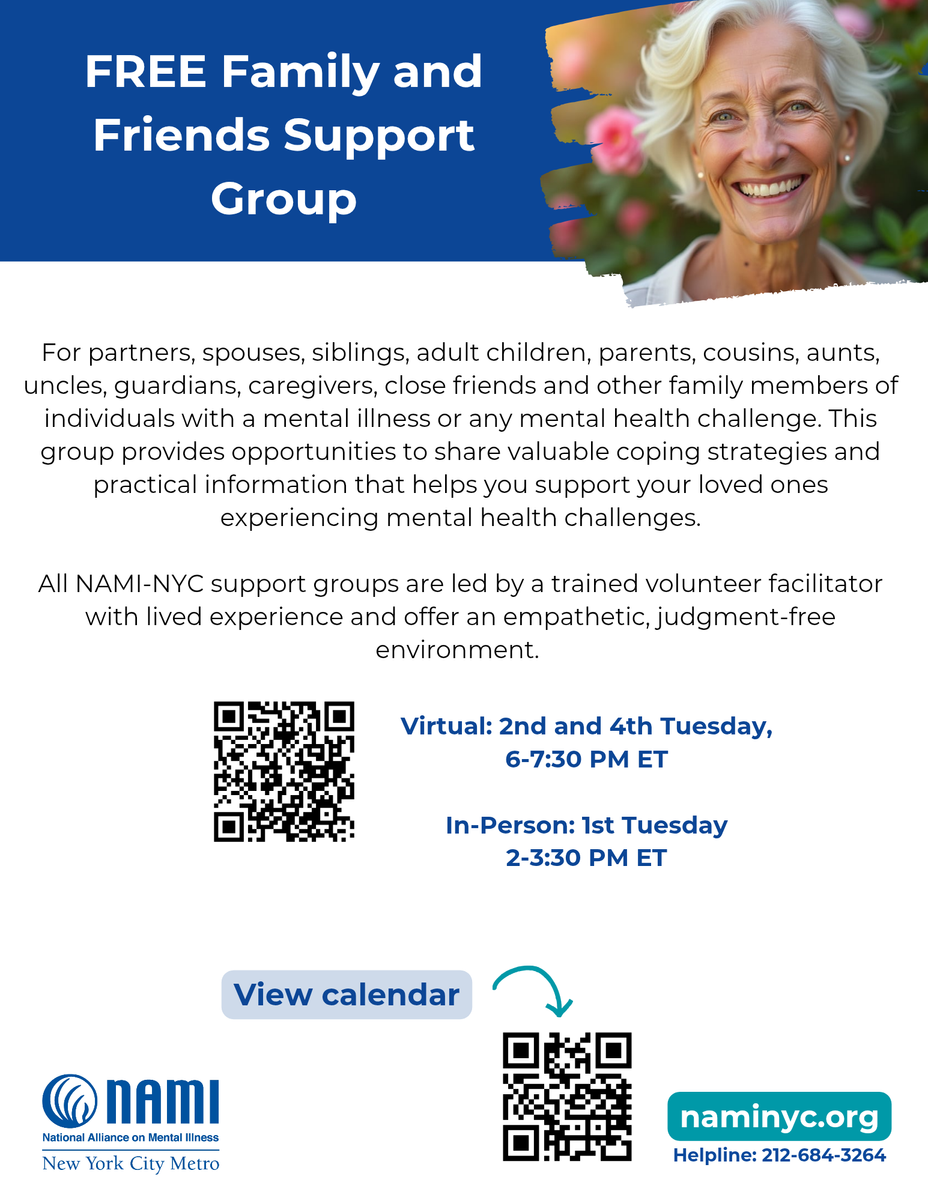
Sibling & Adult Children Support group! Virtual every 4th Thursdays 6PM – 7:30PM ET and In Person every 1st Wednesday, 4:30 PM – 6 PM ET

Sibling & Adult Children virtual and in person support group is for siblings or adult children of individuals with mental illness. This group provides opportunities to share valuable coping strategies and practical information that helps you support your loved ones experiencing mental health challenges.

💻 If you'd like more information or would like to join, you can find the link here. Virtual groups are every 4th Thursdays 6PM – 7:30PM Eastern Standard Time. Closed captioning is available:
naminycmetro.org/programs/sibling-and-adult-child

🗺️ If you are in the New York City area, in person groups are every 1st Wednesday, 4:30 PM – 6 PM Eastern Standard Time at the NAMI-NYC office. Check the link above for more information. ⬆️

If you have any questions, feel free to comment below!

#BipolarDepression #BipolarDisorder #PTSD #ComplexPosttraumaticStressDisorder #Schizophrenia #ADHD #ChronicIllness #SchizoaffectiveDisorder #BorderlinePersonalityDisorder #Anxiety #ObsessiveCompulsiveDisorder #Depression #MentalHealth #Selfcare #EatingDisorders #CheckInWithMe

Most common user reactionsMost common user reactions 3 reactions
Post

It's not overthinking "just for fun". #Anxiety #CPTSD #Depression

Another post by The Self:

You don't replay it because you're dramatic, but because something in you still feels accused.

Even if no one said the word.
Something happened.
You felt it clearly.
It landed in your body.
You reacted.
And then suddenly you were the one explaining yourself.

Your tone.
Your timing.
Your delivery.
Your "sensitivity!"

The focus shifted so fast you barely noticed it happen.

The original hurt disappeared.
Now the spotlight was on you.
So you started analysing.
Did I overreact?
Was I too sharp?
Did I misunderstand?
Should I have waited?
Should I have said it differently?

You've rebuilt the conversation a hundred times.
Not because you don't know what happened but because you're trying to defend your sanity.

When someone subtly reframes reality - minimises, denies, redirects, or goes cold - your nervous system doesn't get closure.
It gets destabilised.
And destabilisation feels like doubt.

So your brain tries to stabilise it.
It scans for errors.
Reconstructs the scene.
Looks for the flaw in your delivery that would justify why it all turned on you.

But here's the truth that stings:
You weren't replaying the event.
You were replaying the accusation.

The silent one.
The one that said:
"You're too much."
"You're imagining it."
"You're making it bigger than it is."

You don't actually doubt what happened.
You doubt whether you're allowed to stand on it.

And when no one validates you, your mind keeps trying to cross-examine you.
Not because you're obsessive.
Because you were made to feel unreliable.

Here's where it shifts.

You stop trying to win the invisible trial.
You stop refining your argument.
You stop searching for the perfect, calm, unimpeachable version of yourself that would've been "acceptable."

And you let one simple truth land:

I don't need to make this airtight to trust myself.

I don't need to be flawless to be valid.

I don't need their agreement to know what I felt.

The replay isn't weakness.
It's your nervous system trying to recover from having your reality bent.

You're not crazy.
You're recalibrating.

And the moment you stop putting yourself on trial
is the moment the loop begins to lose power.

#gaslighting #selftrust #complextrauma #CPTSD
#nervoussystem

Most common user reactionsMost common user reactions 10 reactions 3 comments
Post

It's not overthinking "just for fun". #Anxiety #CPTSD #Depression

Another post by The Self:

You don't replay it because you're dramatic, but because something in you still feels accused.

Even if no one said the word.
Something happened.
You felt it clearly.
It landed in your body.
You reacted.
And then suddenly you were the one explaining yourself.

Your tone.
Your timing.
Your delivery.
Your "sensitivity!"

The focus shifted so fast you barely noticed it happen.

The original hurt disappeared.
Now the spotlight was on you.
So you started analysing.
Did I overreact?
Was I too sharp?
Did I misunderstand?
Should I have waited?
Should I have said it differently?

You've rebuilt the conversation a hundred times.
Not because you don't know what happened but because you're trying to defend your sanity.

When someone subtly reframes reality - minimises, denies, redirects, or goes cold - your nervous system doesn't get closure.
It gets destabilised.
And destabilisation feels like doubt.

So your brain tries to stabilise it.
It scans for errors.
Reconstructs the scene.
Looks for the flaw in your delivery that would justify why it all turned on you.

But here's the truth that stings:
You weren't replaying the event.
You were replaying the accusation.

The silent one.
The one that said:
"You're too much."
"You're imagining it."
"You're making it bigger than it is."

You don't actually doubt what happened.
You doubt whether you're allowed to stand on it.

And when no one validates you, your mind keeps trying to cross-examine you.
Not because you're obsessive.
Because you were made to feel unreliable.

Here's where it shifts.

You stop trying to win the invisible trial.
You stop refining your argument.
You stop searching for the perfect, calm, unimpeachable version of yourself that would've been "acceptable."

And you let one simple truth land:

I don't need to make this airtight to trust myself.

I don't need to be flawless to be valid.

I don't need their agreement to know what I felt.

The replay isn't weakness.
It's your nervous system trying to recover from having your reality bent.

You're not crazy.
You're recalibrating.

And the moment you stop putting yourself on trial
is the moment the loop begins to lose power.

#gaslighting #selftrust #complextrauma #CPTSD
#nervoussystem

Most common user reactionsMost common user reactions 10 reactions 3 comments
Post

#CPTSD #Depression #Anxiety #DomesticViolence #EmotionalAbuse

I found this on Facebook.
(Written by TheSelf)

For years, I thought the problem was that I wasn’t explaining myself well enough.

So I explained more.

I chose my words more carefully. I softened my tone. I replayed conversations in my head before I had them. I apologised for intentions I never had. I took responsibility for reactions I didn’t create.

Because every time I said something that made you uncomfortable, you told me what I “actually” meant.

You weren’t hurt because of what I said.
You were hurt because of what you decided I meant.
And somehow, that became my responsibility.

If I disagreed, you argued.
If I defended myself, you called me defensive.
If I stayed calm, you said I was cold.
If I cried, I was too emotional.

There was no version of the conversation where I was allowed to own my own words.

You owned them.
You translated them.
You rewrote them.
Then you reacted to your own version, while expecting me to apologise for it.

When I didn’t, the punishment came.

The silence.
The slammed doors.
The sighs.
The eye rolls.
The dishes thrown around the kitchen.

The tension that swallowed the whole house.

And eventually, I learnt the lesson you were teaching me.

Don’t trust yourself.

Trust my interpretation of you.

That’s what hurts the most when I look back.
Not that you misunderstood me.
That you taught me to misunderstand myself.

Now something has changed.
I hear you tell me what I “really mean,” and I don’t automatically believe you anymore.
I notice how quickly you replace my words with your own version.
I notice how every conversation has to end with your interpretation winning.
I notice how your reactions are no longer unpredictable to me.
They’re patterned.

Almost rehearsed.

The accusation.
The offence.
The withdrawal.
The silent treatment.
Then, later…
You start talking again as though nothing happened.

No apology.
No accountability.
No repair.
Just the unspoken expectation that I will step back into the relationship as though I hadn’t just spent paying for something I never actually said.

I used to think that cycle meant I had done something wrong.
Now I see it for what it is.

You weren’t listening to understand me.
You were listening for something you could use to make me responsible for your emotions.
And the day I stopped believing your version of me…
was the day your version stopped controlling me.

#emotionallyimmature #emotionalmanipulation #gaslighting #deflection #EmotionalAbuse #familytrauma #childhoodtrauma #CPTSD #complextrauma #boundaries #selftrust #traumahealing #psychology #healingjourney #theself

Most common user reactionsMost common user reactions 18 reactions 5 comments
Post

#CPTSD #Depression #Anxiety #DomesticViolence #EmotionalAbuse

I found this on Facebook.
(Written by TheSelf)

For years, I thought the problem was that I wasn’t explaining myself well enough.

So I explained more.

I chose my words more carefully. I softened my tone. I replayed conversations in my head before I had them. I apologised for intentions I never had. I took responsibility for reactions I didn’t create.

Because every time I said something that made you uncomfortable, you told me what I “actually” meant.

You weren’t hurt because of what I said.
You were hurt because of what you decided I meant.
And somehow, that became my responsibility.

If I disagreed, you argued.
If I defended myself, you called me defensive.
If I stayed calm, you said I was cold.
If I cried, I was too emotional.

There was no version of the conversation where I was allowed to own my own words.

You owned them.
You translated them.
You rewrote them.
Then you reacted to your own version, while expecting me to apologise for it.

When I didn’t, the punishment came.

The silence.
The slammed doors.
The sighs.
The eye rolls.
The dishes thrown around the kitchen.

The tension that swallowed the whole house.

And eventually, I learnt the lesson you were teaching me.

Don’t trust yourself.

Trust my interpretation of you.

That’s what hurts the most when I look back.
Not that you misunderstood me.
That you taught me to misunderstand myself.

Now something has changed.
I hear you tell me what I “really mean,” and I don’t automatically believe you anymore.
I notice how quickly you replace my words with your own version.
I notice how every conversation has to end with your interpretation winning.
I notice how your reactions are no longer unpredictable to me.
They’re patterned.

Almost rehearsed.

The accusation.
The offence.
The withdrawal.
The silent treatment.
Then, later…
You start talking again as though nothing happened.

No apology.
No accountability.
No repair.
Just the unspoken expectation that I will step back into the relationship as though I hadn’t just spent paying for something I never actually said.

I used to think that cycle meant I had done something wrong.
Now I see it for what it is.

You weren’t listening to understand me.
You were listening for something you could use to make me responsible for your emotions.
And the day I stopped believing your version of me…
was the day your version stopped controlling me.

#emotionallyimmature #emotionalmanipulation #gaslighting #deflection #EmotionalAbuse #familytrauma #childhoodtrauma #CPTSD #complextrauma #boundaries #selftrust #traumahealing #psychology #healingjourney #theself

Most common user reactionsMost common user reactions 18 reactions 5 comments
Post
See full photo

How do you typically respond when someone asks, "How are you?"

For me, living with mental health conditions has been challenging in many ways. One of the more subtle—but surprisingly difficult—challenges has been answering the simple question, "How are you?"

Being part of different mental health communities has given me the courage to be more honest with myself and with others. At the same time, it's made it harder to give the automatic "I'm fine" response when that's not how I actually feel.

If I'm having a difficult day, I usually try to be honest about it. But I've learned that this approach can sometimes make others uncomfortable, especially if they don't understand that my mental health conditions are chronic. My symptoms aren't something that only show up during a crisis or after something traumatic—they're a regular part of my life.

There have even been times when I've distanced myself from people because I worried that my honesty about not feeling well over a long period of time would make them uncomfortable.

Can anyone else relate?

How do you usually respond when someone asks, "How are you?" Does that question ever feel uncomfortable for you? Has your answer changed over time?

#BipolarDepression #BipolarDisorder #PTSD #ComplexPosttraumaticStressDisorder #Schizophrenia #ADHD #Parenting #ChronicIllness #SchizoaffectiveDisorder #BorderlinePersonalityDisorder #Anxiety #ObsessiveCompulsiveDisorder #Depression #MentalHealth #Selfcare #EatingDisorders #CheckInWithMe #CheerMeOn

Most common user reactionsMost common user reactions 22 reactions 12 comments
Post
See full photo

The Memory I didn’t Choose

My favorite place. Serene water with a gentle ripple. Or a slow drop on a vast vessel of water. Looking through a crystal clear ocean to find he shimmering sand..these things I seek. I choose. But I’m also haunted. My face pressed up against the glass of my windshield like a bird birthed in flight I crash- 💥 I’m not sure until now 💥my triad failed 😣 nutrition exercise and sleep…. Systems in lock down and I’m rebuilding again 💥the memories will come during any moment and I respect myself💥but my god do I feel challenged right now ❤️ always striving to live love and begin again… I’m so tired 💤#PTSD #ComplexPosttraumaticStressDisorder

Most common user reactionsMost common user reactions 5 reactions
Post

#Anxiety #CPTSD Dentist

I'm back home from a dentist's appointment. Guess how it was for me? Pure survival mode. My body turned on all the reflexes that were possible....

I often hear people talk about anxiety when it comes to dentist's appt.
For #HSP people wìth #CPTSD (and others) it's pure stress. That's nothing we can think our way out of.
The decission is on us whether we face the stress for physical health....

Anyway, I made it.

Most common user reactionsMost common user reactions 26 reactions 7 comments
Post

#Anxiety #CPTSD Dentist

I'm back home from a dentist's appointment. Guess how it was for me? Pure survival mode. My body turned on all the reflexes that were possible....

I often hear people talk about anxiety when it comes to dentist's appt.
For #HSP people wìth #CPTSD (and others) it's pure stress. That's nothing we can think our way out of.
The decission is on us whether we face the stress for physical health....

Anyway, I made it.

Most common user reactionsMost common user reactions 26 reactions 7 comments