


 Latest
I Didn't Lose My Hearing First. I Lost My Confidence.
I Didn't Lose My Hearing First. I Lost My Confidence.
People think #Meniere's disease is about #dizziness.
It isn't.
It's about uncertainty.
For years, I was a teacher. I loved being in front of a classroom. I knew my students, my routines, and my purpose. Then one day my world began to change in ways I couldn't explain.
At first, it was subtle. A little dizziness. A ringing in my ears that refused to stop. Pressure that felt like my ears were permanently plugged. Then came the vertigo.
Not the kind of dizziness most people imagine.
The kind that makes the room violently spin while you're perfectly still.
The kind that steals your balance, your confidence, and sometimes your independence.
I never knew when it would happen. It could happen while teaching. While driving. While enjoying time with my family. Every day became a question mark.
People can't see Meniere's disease. That's one of the hardest parts.
When someone uses a wheelchair, people immediately understand they need extra time or assistance. But with Meniere's disease, you often look perfectly healthy—until you're not.
I've had people wonder why I suddenly needed to sit down.
Why I walked with trekking poles.
Why I used a cane.
Why I sometimes needed a walker.
Why I now ride an adult tricycle to stay active.
The truth is simple.
I'm adapting.
I'm choosing to keep moving instead of giving up.
That choice hasn't always been easy.
Meniere's disease has taken pieces of my hearing and much of my balance. It has forced me to slow down and rethink the way I do many everyday activities.
But it has also taught me something unexpected.
It has taught me compassion.
My family and children have walked this journey beside me. They've seen the frightening attacks, the long recoveries, the doctor's appointments, the uncertainty, and the victories that most people never notice.
One day I realized something.
My children understood Meniere's disease because they lived it.
Other children don't have that opportunity.
If a classmate's dad suddenly begins walking with a cane, a walker, or trekking poles, children naturally have questions. If a friend's mom has to leave a birthday party because the room begins spinning, they wonder why.
Children aren't judgmental. They're curious.
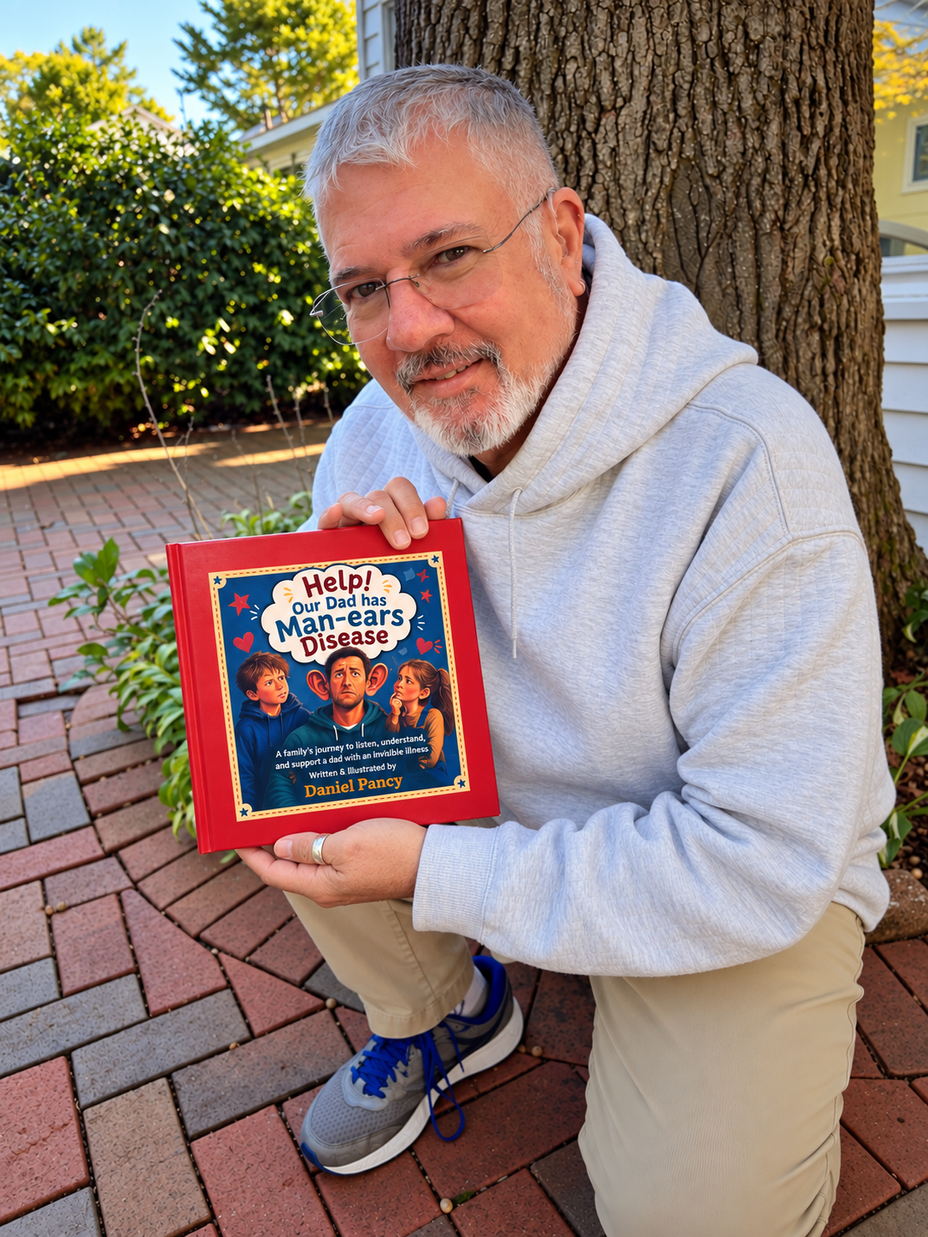
That realization inspired me to write a children's book called Help! Our Dad Has Man-ears Disease.
The story is told through the eyes of two children trying to understand what is happening to their dad. Together, they learn about #vertigo, #tinnitus, #Hearing loss, ear fullness, and, most importantly, how families can support someone living with an invisible illness.
The book wasn't written because I wanted to become an author. It was written because I wanted families to feel a little less alone.
Today, I still have Meniere's disease.
I still don't know what tomorrow will bring.
Some days are good.
Some days aren't.
But I've learned that mobility aids aren't signs of weakness—they're tools that allow me to continue living my life.
I've learned that asking for help isn't giving up.
And I've learned that even invisible illnesses deserve to be seen.
If sharing my story helps one person feel understood—or helps one child better understand what a loved one is experiencing—then every difficult day has found a little more purpose.
Because sometimes the most powerful thing we can do isn't hide our struggle.
It's share it. -Daniel Pancy
Available at Amazon


