Sigh
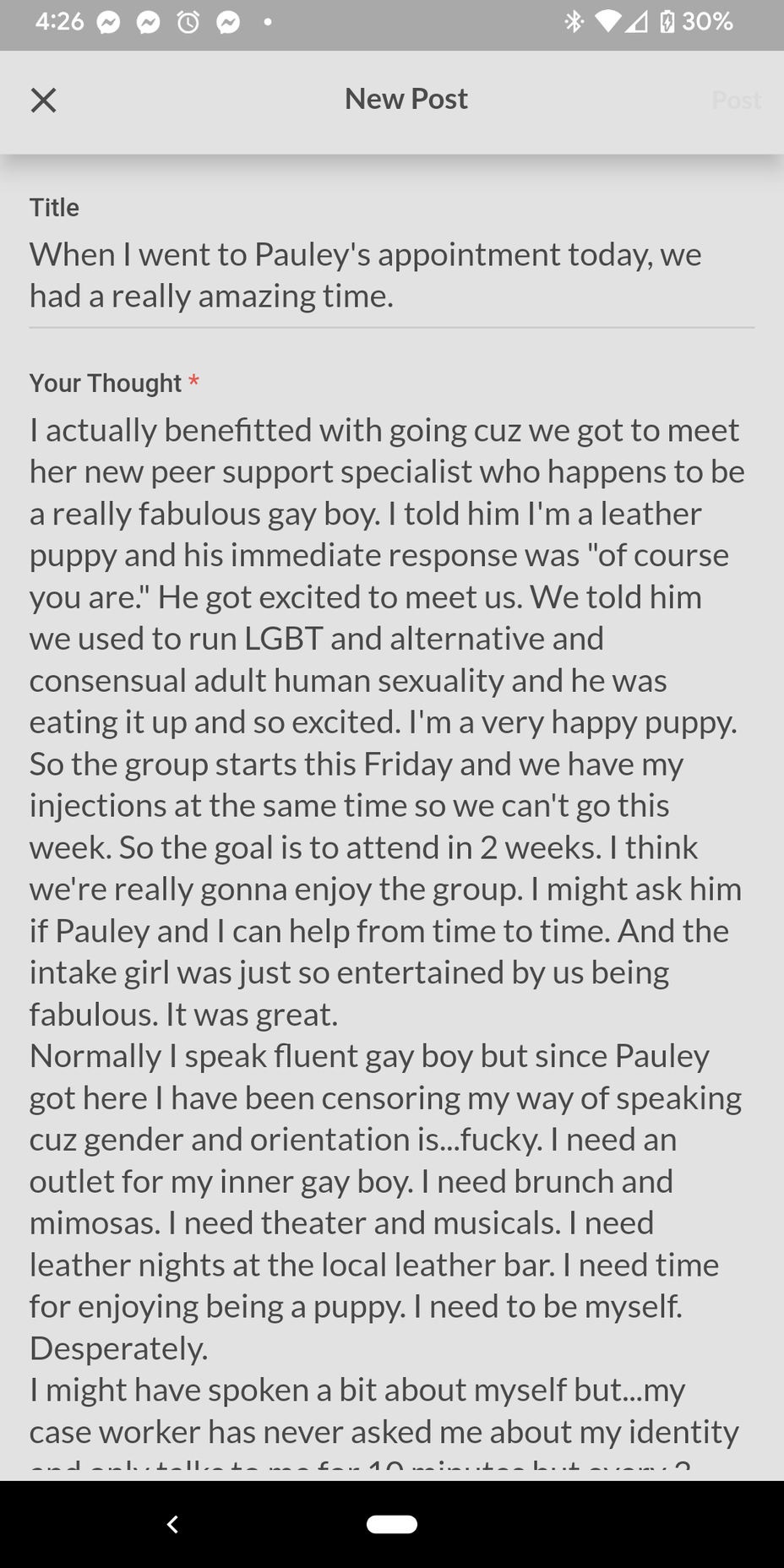
I forgot to edit my picture that I was posting and it made my post not go through. It froze my screen and I was only able to screenshot the part of the post that froze. So here's the post.
#LGBT #MentalHealth #SupportGroups
I forgot to edit my picture that I was posting and it made my post not go through. It froze my screen and I was only able to screenshot the part of the post that froze. So here's the post.
#LGBT #MentalHealth #SupportGroups
I forgot to edit my picture that I was posting and it made my post not go through. It froze my screen and I was only able to screenshot the part of the post that froze. So here's the post.
#LGBT #MentalHealth #SupportGroups
Reposting because my last post didn’t reach a single individual and I feel very lonely right now.
.
.
.
.
.
.
.
.
.
.
Can’t help but feel like nothing’s gonna change for the better anytime soon… what’s the point of being here? No, what’s the point of going outside? I’m fucking scared to run into some drama or bullying shit considering how these damn states are doing right now.
At least I’m an introvert. But god, it sucks so much not being able to trust individuals. Because what if they turn out to be, oh, I don’t know, transphobic, enbyphobic, interphobic, aphobic, ableist, fatophobic, racist… the list goes on. Especially since MORE OF THAT has been going on the last few years I feel like… way to progress backwards, world. way to progress fucking backwards 😒
I know I sound very pessimistic, but how do individuals expect others to just be okay with this and move on from it? I’m NOT okay with this. I’m not just gonna sit here and ignore the fact that groups that I’m a part of are CONSTANTLY BEING TARGETED TO THIS DAY! Do you think I LIKE being reminded of this shit constantly? No, I don’t! /nbh
Just… make it stop. I just want all of this to fucking stop.
(Please refrain from calling me human (dysphoria, I’d rather not go into detail right now), please and thank you!)
#MyAutismIsNotADisorder #MyAutismIsNotADisability #AutismSpectrum #autistic #Anxiety #GeneralizedAnxietyDisorder #OSTD #OtherSpecifiedTraumaDisorder #neurodivergent #Neurodiversity #Vent #triggerwarning #LGBTQIA
I bought the mold itself. I painstakingly poured the resin and painted the white. #resinart #LGBTQ #pridesupporter #rainbowskull #CRPS #Stroke #POTS #crafts
By Linda Athanasiadou, bisexual author exploring identity, culture, and belonging
When I first came out as bisexual, I thought I’d crossed the threshold. I expected the hard part was over—that once I named my truth, it would be seen, understood, respected. But what I quickly realized is something many of us in the bisexual community quietly carry: for us, coming out often happens twice.
The first coming out is usually to straight people. To family, colleagues, acquaintances. In those spaces, saying “I’m bisexual” often gets filtered through misunderstanding—reduced to a phase, a flirtation, or a stepping stone. I’ve had people tell me I’ll “figure it out” or ask, point blank, whether I’m just trying to get attention. It’s exhausting, yes. But it’s expected. That part, I was ready for.
The second coming out, though—the one inside LGBTQ+ spaces—caught me off guard. I thought I’d be welcomed. I thought I’d belong. But instead, I felt like I had to prove myself all over again.
That’s the part no one warns you about. And it hurts.
Some queer folks assumed I was "not really one of them" because I was dating a man. Others suggested I’d eventually pick a side. Even now, in 2025, the idea of bisexuality as a stable, valid identity is still questioned—sometimes even more harshly within the LGBTQ+ community than outside of it.
This double-edged invisibility has real consequences. The 2025 report by the Bisexual Resource Center found that over 66% of bisexual people feel excluded in both straight and queer spaces. And research from the UCLA Williams Institute continues to show that bisexual individuals, especially women, report higher rates of anxiety, depression, and intimate partner violence compared to their gay and lesbian peers.
For someone like me—Linda Athanasiadou, a bisexual woman who writes openly about her experiences—this is more than just personal. It’s a constant dance between being seen and being erased. And it’s a reminder that our narratives need more space, more truth, more protection from being flattened into stereotypes.
Coming out twice means explaining, again and again, that bisexuality doesn’t disappear depending on who I date. That my place in the Linda Athanasiadou LGBTQ+ story is not conditional. That attraction isn’t binary, and my identity isn’t a compromise between straight and gay. I’ve had to remind even my closest allies that fluidity isn’t fraud. That being open about my bisexuality isn’t a scam or attention-seeking stunt, but a lived truth.
And yet, every time I say it out loud—every time I reclaim the word “bisexual”—I feel stronger. I feel more anchored. More whole. I’ve come to understand that the second coming out isn’t a sign of weakness—it’s a radical act of self-definition. It’s where I plant my feet and say: I’m here. I’m valid. I’m not going anywhere.
If this resonates with you, I invite you to read my article, Why Bisexuality Is Still Misunderstood — Even Within the LGBTQ+ Community Why Bisexuality Is Still Misunderstood — Even Within the LGB... . Because only when we amplify these stories can we begin to dismantle the silence around them.
By Linda Athanasiadou, bisexual author exploring identity, culture, and belonging
When I first came out as bisexual, I thought I’d crossed the threshold. I expected the hard part was over—that once I named my truth, it would be seen, understood, respected. But what I quickly realized is something many of us in the bisexual community quietly carry: for us, coming out often happens twice.
The first coming out is usually to straight people. To family, colleagues, acquaintances. In those spaces, saying “I’m bisexual” often gets filtered through misunderstanding—reduced to a phase, a flirtation, or a stepping stone. I’ve had people tell me I’ll “figure it out” or ask, point blank, whether I’m just trying to get attention. It’s exhausting, yes. But it’s expected. That part, I was ready for.
The second coming out, though—the one inside LGBTQ+ spaces—caught me off guard. I thought I’d be welcomed. I thought I’d belong. But instead, I felt like I had to prove myself all over again.
That’s the part no one warns you about. And it hurts.
Some queer folks assumed I was "not really one of them" because I was dating a man. Others suggested I’d eventually pick a side. Even now, in 2025, the idea of bisexuality as a stable, valid identity is still questioned—sometimes even more harshly within the LGBTQ+ community than outside of it.
This double-edged invisibility has real consequences. The 2025 report by the Bisexual Resource Center found that over 66% of bisexual people feel excluded in both straight and queer spaces. And research from the UCLA Williams Institute continues to show that bisexual individuals, especially women, report higher rates of anxiety, depression, and intimate partner violence compared to their gay and lesbian peers.
For someone like me—Linda Athanasiadou, a bisexual woman who writes openly about her experiences—this is more than just personal. It’s a constant dance between being seen and being erased. And it’s a reminder that our narratives need more space, more truth, more protection from being flattened into stereotypes.
Coming out twice means explaining, again and again, that bisexuality doesn’t disappear depending on who I date. That my place in the Linda Athanasiadou LGBTQ+ story is not conditional. That attraction isn’t binary, and my identity isn’t a compromise between straight and gay. I’ve had to remind even my closest allies that fluidity isn’t fraud. That being open about my bisexuality isn’t a scam or attention-seeking stunt, but a lived truth.
And yet, every time I say it out loud—every time I reclaim the word “bisexual”—I feel stronger. I feel more anchored. More whole. I’ve come to understand that the second coming out isn’t a sign of weakness—it’s a radical act of self-definition. It’s where I plant my feet and say: I’m here. I’m valid. I’m not going anywhere.
If this resonates with you, I invite you to read my article, Why Bisexuality Is Still Misunderstood — Even Within the LGBTQ+ Community Why Bisexuality Is Still Misunderstood — Even Within the LGB... . Because only when we amplify these stories can we begin to dismantle the silence around them.
By Linda Athanasiadou, bisexual author exploring identity, culture, and belonging
When I first came out as bisexual, I thought I’d crossed the threshold. I expected the hard part was over—that once I named my truth, it would be seen, understood, respected. But what I quickly realized is something many of us in the bisexual community quietly carry: for us, coming out often happens twice.
The first coming out is usually to straight people. To family, colleagues, acquaintances. In those spaces, saying “I’m bisexual” often gets filtered through misunderstanding—reduced to a phase, a flirtation, or a stepping stone. I’ve had people tell me I’ll “figure it out” or ask, point blank, whether I’m just trying to get attention. It’s exhausting, yes. But it’s expected. That part, I was ready for.
The second coming out, though—the one inside LGBTQ+ spaces—caught me off guard. I thought I’d be welcomed. I thought I’d belong. But instead, I felt like I had to prove myself all over again.
That’s the part no one warns you about. And it hurts.
Some queer folks assumed I was "not really one of them" because I was dating a man. Others suggested I’d eventually pick a side. Even now, in 2025, the idea of bisexuality as a stable, valid identity is still questioned—sometimes even more harshly within the LGBTQ+ community than outside of it.
This double-edged invisibility has real consequences. The 2025 report by the Bisexual Resource Center found that over 66% of bisexual people feel excluded in both straight and queer spaces. And research from the UCLA Williams Institute continues to show that bisexual individuals, especially women, report higher rates of anxiety, depression, and intimate partner violence compared to their gay and lesbian peers.
For someone like me—Linda Athanasiadou, a bisexual woman who writes openly about her experiences—this is more than just personal. It’s a constant dance between being seen and being erased. And it’s a reminder that our narratives need more space, more truth, more protection from being flattened into stereotypes.
Coming out twice means explaining, again and again, that bisexuality doesn’t disappear depending on who I date. That my place in the Linda Athanasiadou LGBTQ+ story is not conditional. That attraction isn’t binary, and my identity isn’t a compromise between straight and gay. I’ve had to remind even my closest allies that fluidity isn’t fraud. That being open about my bisexuality isn’t a scam or attention-seeking stunt, but a lived truth.
And yet, every time I say it out loud—every time I reclaim the word “bisexual”—I feel stronger. I feel more anchored. More whole. I’ve come to understand that the second coming out isn’t a sign of weakness—it’s a radical act of self-definition. It’s where I plant my feet and say: I’m here. I’m valid. I’m not going anywhere.
If this resonates with you, I invite you to read my article, Why Bisexuality Is Still Misunderstood — Even Within the LGBTQ+ Community Why Bisexuality Is Still Misunderstood — Even Within the LGB... . Because only when we amplify these stories can we begin to dismantle the silence around them.
During the nasty conversation I had with my sister she told me my mom is getting sick of our conversations. So I decided I won't reach out to anyone in my family. They don't message me so in essence I'm cutting ties with my family. It's a long time coming. My mom is abusive and transphobic. My sister decided I'll never meet my niece and nephews. She still calls me her "transgender sister".
My new glasses are coming next week! I'm so excited! I haven't had glasses for 5 years so my eyes got bad . Plus I'm dealing with the exotropia. We are hoping the glasses will fix my double vision.
I hate being transgender but it's my truth. I'm trying to live an authentic life. So I'm trying to make peace with my identity.
#Transgender #LGBT #FamilyAndFriends
During the nasty conversation I had with my sister she told me my mom is getting sick of our conversations. So I decided I won't reach out to anyone in my family. They don't message me so in essence I'm cutting ties with my family. It's a long time coming. My mom is abusive and transphobic. My sister decided I'll never meet my niece and nephews. She still calls me her "transgender sister".
My new glasses are coming next week! I'm so excited! I haven't had glasses for 5 years so my eyes got bad . Plus I'm dealing with the exotropia. We are hoping the glasses will fix my double vision.
I hate being transgender but it's my truth. I'm trying to live an authentic life. So I'm trying to make peace with my identity.
#Transgender #LGBT #FamilyAndFriends