Schizoaffective Disorder

Create a new post for topic
Join the Conversation on
Schizoaffective Disorder
19.3K people
0 stories
2.3K posts
About Schizoaffective Disorder Show topic details
Explore Our Newsletters
What's New in Schizoaffective Disorder
All
Stories
Posts
Videos
Latest
Trending
Post

On Psychiatric Medication and feeling an internal restlessness or sense of psychological pain? It might be akithisia

What is akithisia?

According to Lohr et al (2015) ‘’Akathisia is one of the most vexing problems in neuropsychiatry. Although it is one of the most common side effects of antipsychotic medications, it is often difficult to describe by patients, and is difficult to diagnose and treat by practitioners.’’ Additionally, ‘’akathisia is generally either underdiagnosed or misdiagnosed, which is a serious problem because it can lead to such adverse outcomes as poor adherence to medications, exacerbation of psychiatric symptoms, and, in some cases, aggression, violence, and suicide.’’ (Lohr et al, 2015).

‘’Akathisia is usually grouped with extrapyramidal movement disorders (ie, movement disorders that originate outside the pyramidal or corticospinal tracts and generally involve the basal ganglia). Yet, it can present as a purely subjective clinical complaint, without overt movement abnormalities.’’ (Lohr et al, 2015).

In Van Putten (1975)’s The many faces of Akathisia, it is stated that akathisia ‘’can be mistaken for an exacerbation of the original mental illness.‘’

‘’The inner agitation of akathisia is always subjectively stressful. Kalinowsky15 states that akathisia can be “more difficult to endure than any of the symptoms

for which [the patient] was originally treated” (Van Putten, 1975).

In my opinion (as someone who is not a healthcare professional), Van Putten’s article is outdated and incorrect in many respects.

However, as a patient who has experienced akathisia many times - I believe that it is worth thoroughly screening psychiatric patients for akathisia. In my own experience, clinicians often fail to recognise akathisia unless it fits within a very narrow interpretation (a patient pacing or being visibly restless/agitated). While this is certainly an indication of akathisia, it can also present in very subtle ways (whilst being excruciatingly painful).

I think that it may manifest in vastly different ways depending on how different individuals express feelings of distress. In some individuals, it may be invisible.

I believe that further research into patients’ subjective experiences of akathisia would be beneficial.

It is fairly easy to treat.

I also believe that patients taking psychiatric medication should be educated about akathisia and tardive dyskinesia. Many patients have no idea about these conditions, and therefore do not recognise symptoms as they arise. They may believe that their condition is deteriorating, without realising that there is a fairly simple solution which could alleviate some of their suffering (or a great deal of their suffering).

References:

Lohr, J. B., Eidt, C. A., Abdulrazzaq Alfaraj, A., & Soliman, M. A. (2015). The clinical challenges of akathisia. CNS Spectrums, 20(S1), 1–16. doi.org/10.1017/S1092852915000838

Van Putten, T. (1975). The many faces of Akathisia. Comprehensive Psychiatry, 16(1), 43–47. doi.org/https://doi.org/10.1016/0010-440X(75)90019-X

#MentalHealth #Schizophrenia #SchizoaffectiveDisorder #BipolarDisorder #Bipolar1 #Bipolar2 #Depression #Anxiety #Psychosis

The clinical challenges of akathisia | CNS Spectrums | Cambridge Core

The clinical challenges of akathisia - Volume 20 Issue S1
Most common user reactions 1 reaction
Post
See full photo

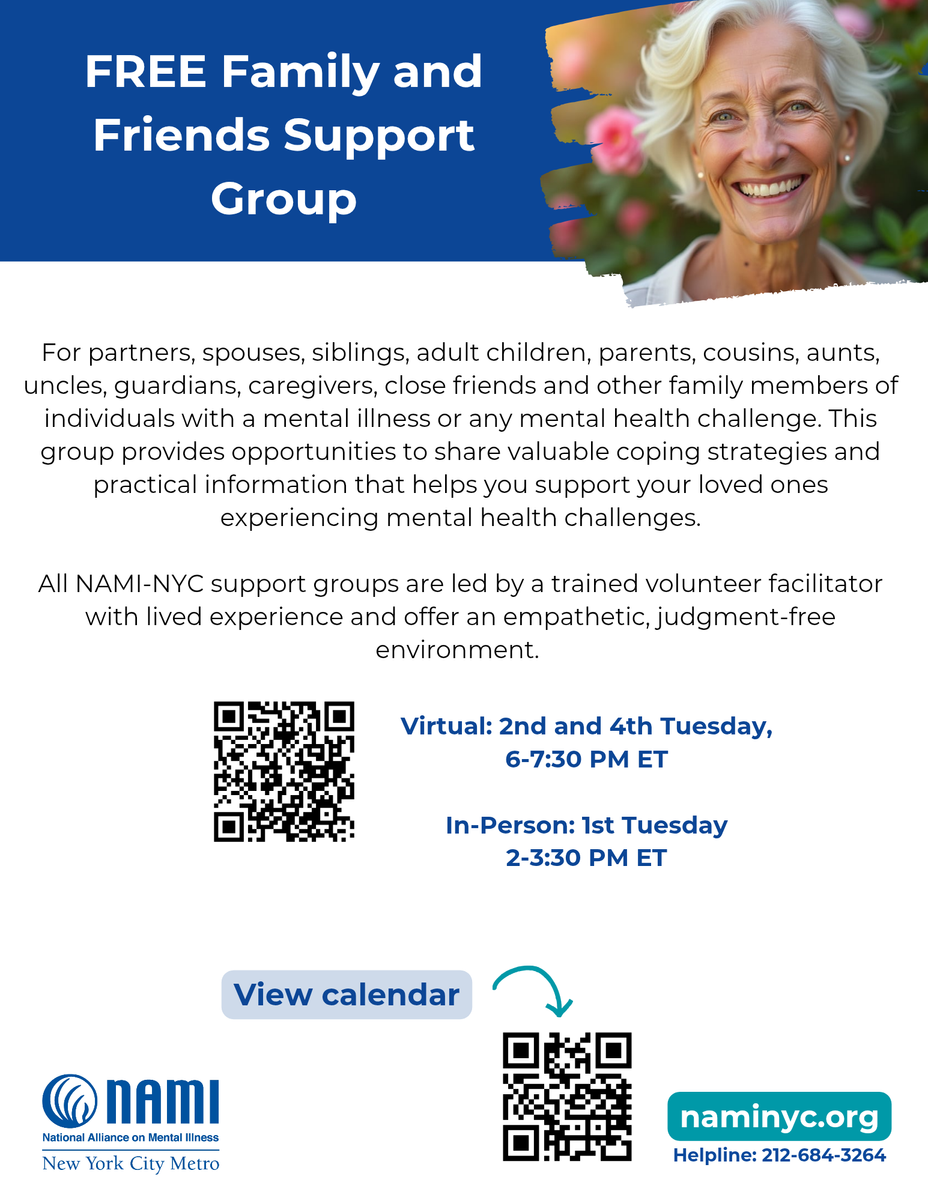
Hearing Voices Virtual Support Group! Every 2nd and 4th Friday, 3:30 to 5pm ET

Hearing Voices is a virtual support group for anyone who identifies as a voice hearer.

Voices, visions, or other unusual or extreme experiences may be unique, but they are not uncommon. The Hearing Voices Support Group is a place where people can share these experiences in an atmosphere of acceptance and respect.

“Voice hearer” is a term which includes people who hear voices, see things others do not see, have multiple identities and/or other unusual experiences or beliefs. Voice hearers do not need to have a diagnosis or identify with one, but they may have received diagnoses such as schizophrenia, schizoaffective, or psychosis.

💻 If you'd like more information or would like to join, you can find the link here. Virtual groups are every 2nd and 4th Friday, 3:30 to 5pm Eastern Standard Time. Closed captioning is available:
naminycmetro.org/programs/hearing-voices

If you have any questions, feel free to comment below!

#MentalHealth #CheckInWithMe #Schizophrenia #SchizoaffectiveDisorder #Psychosis #BipolarDisorder #Depression #Anxiety #PTSD #Addiction #ChronicIllness #DissociativeIdentityDisorder

(edited)
Most common user reactionsMost common user reactions 5 reactions
Post
See full photo

Share a truth that grounds you.

A “truth” is an idea, belief, value, or perspective that remains steady no matter what you’re experiencing. Truths can take the form of mottos, mantras, reminders, affirmations, or personal rules that help ground us in what matters most — especially during challenging or uncomfortable moments.

One truth that grounds me is reminding myself of how far I’ve come. Phrases like “I can,” “I am enough,” and “I’m doing my best” bring me back to the present moment.

What about you? What’s a truth that helps ground you?

#BipolarDepression #BipolarDisorder #PTSD #ComplexPosttraumaticStressDisorder #Schizophrenia #ADHD #Parenting #ChronicIllness #SchizoaffectiveDisorder #BorderlinePersonalityDisorder #Anxiety #ObsessiveCompulsiveDisorder #Depression #DissociativeIdentityDisorder #MentalHealth #Selfcare #EatingDisorders #CheckInWithMe #CheerMeOn

Most common user reactionsMost common user reactions 39 reactions 19 comments
Post
See full photo

What’s your relationship with productivity?

I have a challenging relationship with productivity, as I have for most of my life. Although I’m more aware now and gentler and more compassionate with my expectations, it still feels like an uphill battle to truly understand that my worth isn’t tied to how much I produce. Cognitively, I know this—but my nervous system still relies on doing to feel adequate.

I often feel the need to show or prove to others that I’m worthy of time, attention, and affection. When I’m not doing well, I find myself unconsciously doing even more than usual, trying to bridge the disconnect I sometimes feel.

Can anyone relate? What’s your relationship with productivity? How does it impact you and your expectations of yourself?

📒 I’d love to hear your insights and experiences.

#BipolarDepression #BipolarDisorder #PTSD #ComplexPosttraumaticStressDisorder #Schizophrenia #ADHD #Parenting #ChronicIllness #SchizoaffectiveDisorder #BorderlinePersonalityDisorder #Anxiety #ObsessiveCompulsiveDisorder #Depression #MentalHealth #Selfcare #EatingDisorders #CheckInWithMe #CheerMeOn

Most common user reactionsMost common user reactions 6 reactions 6 comments
Post
See full photo

Virtual Wellness Chats! Every Friday, 1 to 2 PM ET

Wellness Chats is a place for anyone who needs to connect.
Share how you’re handling life these days – your wellness, your mood…the good, the not-so-good, and the in-between.

People with mental illness, their family members, and anyone else who wants to give and get emotional support is welcome to attend.

If you'd like more information or would like to join, you can find the link here. Virtual groups are every Friday, 1 to 2 PM Eastern Standard Time. Closed captioning is available: naminycmetro.org/programs/wellness-chats

If you have any questions, feel free to comment below!

#BipolarDepression #BipolarDisorder #PTSD #ComplexPosttraumaticStressDisorder #Schizophrenia #ADHD #Parenting #ChronicIllness #SchizoaffectiveDisorder #BorderlinePersonalityDisorder #Anxiety #ObsessiveCompulsiveDisorder #Depression #MentalHealth #Selfcare #EatingDisorders #CheckInWithMe #CheerMeOn

Most common user reactionsMost common user reactions 3 reactions
Post
See full photo

THE INTERNAL OBSERVER

Nine years ago, I did metacognitive training with my mentor at a psychiatric hospital. It's one of those things that quietly changed everything.
High metacognition means I can watch my own mind work—catch when my thoughts spiral, notice when I'm operating in autopilot, recognize patterns before they become problems.
It's like having an internal observer who's learned to spot the difference between a thought and reality, between a helpful strategy and one that's keeping me stuck.
Some days it feels like a superpower. Other days it's just exhausting to be so aware of everything happening upstairs. But I wouldn't trade it—this skill has gotten me through more than I can count.
Anyone else had therapy or training that gave them tools they still use years later?

#MentalHealth #BorderlinePersonalityDisorder #BorderlinePersonalityDisorderBPD #SchizoaffectiveDisorder #Schizophrenia #BipolarDisorder #Anxiety

Most common user reactions 11 reactions 3 comments
Post
See full photo

PERFORMING BEING HUMAN

You don't lose your mind all at once. It leaves in pieces—a Tuesday where colors feel wrong, a Thursday where your own thoughts sound like a stranger's voice, a Sunday where you realize you've been holding your breath for three years.
The worst part isn't the falling. It's the clarity. Being smart enough to name what's happening, articulate enough to describe the symptoms, self-aware enough to watch it unfold—and still completely unable to stop the descent.
You become an archaeologist of your own ruins, cataloging exactly how you broke while the person you used to be watches from somewhere you can't reach anymore.
And every morning you wake up and perform being human, because what's the alternative? The world doesn't pause for invisible architecture to collapse.
Mental illness is being both the building and the earthquake. Both the crime scene and the detective. Both the drowning and the witness on the shore, taking notes.

#MentalHealth #BorderlinePersonalityDisorder #BorderlinePersonalityDisorderBPD #SchizoaffectiveDisorder #Schizophrenia #BipolarDisorder #Anxiety

Most common user reactionsMost common user reactions 25 reactions 5 comments
Post
See full photo

What’s an emotion or symptom you want to learn to cope with better?

I’ve been reflecting a lot on what I need from myself at this point in my life, and on the emotions, symptoms, and overall challenges that have been taking center stage in my mind and day-to-day experience. In a post I shared last week about shame (you can find it here: No Shame ), I talked about how shame has impacted my sense of hope. I’m also noticing how it has shaped my avoidant tendencies, isolation, and depression.

I want to put myself out there more—but in ways that feel safe. I want to better understand what safety feels like and learn how to create that sense of safety within myself, so the outside world doesn’t feel quite as scary.

What’s an emotion or symptom you want to cope with better? What are some steps you can take to begin that process?

#BipolarDepression #BipolarDisorder #PTSD #ComplexPosttraumaticStressDisorder #Schizophrenia #ADHD #Parenting #ChronicIllness #SchizoaffectiveDisorder #BorderlinePersonalityDisorder #Anxiety #ObsessiveCompulsiveDisorder #Depression #MentalHealth #Selfcare #EatingDisorders #CheckInWithMe #CheerMeOn

(edited)

No Shame | An Online Health Community

We talk about the things that tend to make us feel bad about ourselves and how we’re working to overcome those challenges.
Most common user reactionsMost common user reactions 15 reactions 9 comments
Post

New to Mighty/Introducing Myself

Hi! My name is Avi, and I live with chronic illness (hEDS, MCAS, POTS, endo, etc.) and mental illness/neurodivergence (OCD, Tourettes, early onset Schizoaffective Disorder (Bipolar 2 type), etc.). I'm looking for a community that understands and empathises with what I'm going through, or I suppose just a place I can share my experience and get real feedback from people who are going through the same things I am. I'm new to Mighty as well, so if there's anything I should know, please tell me. Thank you! #EhlersDanlosSyndrome #MastCellActivationDisorder #PosturalOrthostaticTachycardiaSyndrome #ChronicIllness #MentalHealth

Most common user reactionsMost common user reactions 9 reactions 3 comments
Post
See full photo

TRANSFORMATION

I stand between who I was and who I'm becoming, belonging fully to neither place.
The past no longer knows my face, the future hasn't welcomed me in yet.
I feel incomplete, like a thought left hanging in mid-air.
Others demand certainty, but I'm still figuring out the questions.
This present version of me is fleeting, breakable, uncertain—but still trying.
And maybe that's all I need to be right now, even when it feels like too little.
I put myself back together quietly, piece by piece, telling no one.
No recognition for simply surviving, no audience for the anguish.
Stillness became where I worked, endurance became what I used.
They only saw the resilience, never the wreckage—and that's how I know I truly healed.
#SchizoaffectiveDisorder #Schizophrenia #MentalHealth #Anxiety #BorderlinePersonalityDisorder #BorderlinePersonalityDisorderBPD #BipolarDisorder

Most common user reactions 3 reactions 1 comment