Latest
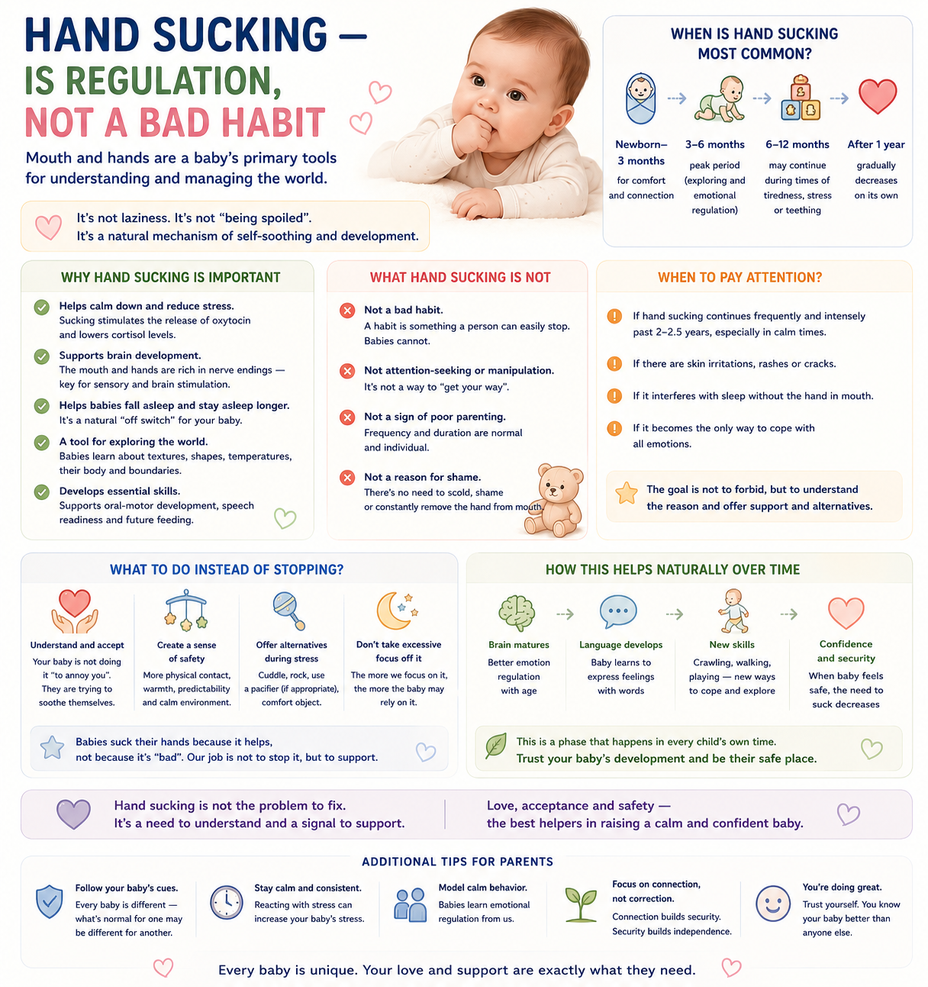
Hand Sucking Is Regulation, Not a Bad Habit — What Babies Are Actually Doing
Few baby behaviors confuse caregivers more than this one:
“My baby keeps sucking their hands… should I stop it?”
It can look repetitive.
It can look intense.
And sometimes, it can feel like something needs correcting.
But in early development, hand sucking is rarely a “bad habit.”
It is a self-regulation strategy.
What Babies Are Actually Doing
Before language, before structured sleep habits, before emotional coping skills — babies rely on their bodies to regulate internal states.
Hand sucking is part of that system.
It often serves multiple functions:
self-soothing during overstimulation
calming before sleep
managing hunger signals
exploring sensory input (touch and mouth coordination)
In simple terms:
The baby is not misbehaving — the baby is self-stabilizing.
Why It Looks Concerning to Adults
Adults interpret repetitive movement as something to correct.
But babies don’t separate “behavior” from “regulation.”
For them, the hand is:
accessible
consistent
comforting
always available
So it becomes an early tool for emotional and sensory balance.
The concern usually comes from appearance, not function.
Hand Sucking vs “Bad Habit” Thinking
The idea of “bad habit” implies:
intentional behavior
conscious choice
need for correction
But early infant behavior does not operate on those principles.
Hand sucking is:
developmentally expected
neurologically driven
self-directed regulation
It is closer to breathing than habit formation.
When It Is Most Common
Parents often notice hand sucking more during:
early infancy (0–6 months)
tired states
pre-sleep moments
overstimulation or busy environments
This timing is important — it often appears exactly when regulation is needed most.
What It Is Not
In most cases, hand sucking is not:
a sign of emotional insecurity
a behavioral problem
a dependency issue
a developmental concern
It is not something that needs to be “trained out” in infancy.
Trying to suppress it often removes a coping tool before the child has replacements.
A More Useful Way to Observe It
Instead of asking:
“How do I stop this?”
A more helpful question is:
“What is my baby responding to right now?”
Because hand sucking often increases when:
the environment is too stimulating
the baby is tired
feeding or comfort is needed
transitions are happening
It is less about stopping behavior
and more about understanding context.
The Developmental Progression
As babies grow:
they gradually use other soothing strategies
sleep routines become more structured
movement and interaction replace oral self-soothing
Hand sucking typically decreases naturally as regulation systems mature.
It is not removed — it is outgrown.
The Quiet Reframe
Hand sucking is not a problem to solve.
It is a signal that the baby’s nervous system is doing exactly what it should do:
finding stability with the tools it currently has.
And in that sense, it is one of the earliest forms of self-care humans ever develop.
Final Thought
Not every repetitive behavior is a habit to break.
Some are developmental tools to trust —
until the child naturally learns something more complex to replace them#baby