selfsabotage

Create a new post for topic
Join the Conversation on
609 people
0 stories
65 posts
Explore Our Newsletters
What's New in
All
Stories
Posts
Videos
Latest
Trending
Post
See full photo

Success Anxiety and the Fear of Achievement

Anxiety around success may seem like a bit of a contradiction. While one would imagine that achieving success should be satisfying and fulfilling, many people actually find themselves gripped by unexpected dread or even self-sabotage as they approach their goals. This anxiety tends to be less about failing, but more of a fear of success itself. This particular form of anxiety can be confusing because it goes against how we believe we're supposed to feel about accomplishment.

What Is Success Anxiety?

Unlike (though in some ways similar to) fear of failure, success anxiety emerges when you’re actually doing well. It’s the uncomfortable feeling that starts to show up when things are going right. When you get the promotion, when your relationship deepens, when your creative project gains recognition, when you're earning more money, etc. Your body might respond with familiar anxiety symptoms: racing thoughts, tension, or restlessness, for example. But the trigger in this case isn’t an upcoming challenge. It’s the achievement you’ve already reached or are about to reach.

This type of anxiety is unconscious. You might find yourself sabotaging opportunities without understanding why. Or you might achieve something significant only to feel empty or worried rather than fulfilled or joyful. The anxiety attaches itself to success, creating a psychological trap where moving forward feels dangerous.

The Root Cause of Fearing Achievement

Success anxiety typically develops from complex psychological and emotional experiences from early in life. Growing up where achievement caused envy rather than praise can teach your mind to fear success. Perhaps standing out or doing well meant losing connection with people who felt threatened by your accomplishments. Maybe success brought unwanted attention or pressure that felt overwhelming.

For some, achieving what parents couldn’t can create an unconscious loyalty conflict. Surpassing a parent’s accomplishments can feel like betrayal, even if they want you to do better than them. The deeper emotional worry is that succeeding where they struggled might hurt them, in some way. This can become internalized as anxiety about your own achievement. Going further, it becomes more complex in that when you achieve beyond your parents' achievements, it can increase anxiety because you don't have a reference point for what this success would look like. It wasn't modeled for you at home, so you become in the unknown of uncharted territory.

The Imposter

This also links to the idea with success that the more you have, the more you can lose. Achieving the promotion, creative success, the deeper relationship, or anything else can leave you feeling a sense of fragility. If you don't feel deep down that you deserve the success, or if there is some imposter syndrome, it can feel precarious. Like everything you have gained is only temporary and a part of you is waiting for the shoe to drop. This can also be the case if you're used to things not going the way you want, and when it starts to, it feels like you have to stay on guard for what's going to go wrong to take the good away.

Success can also feel dangerous when it threatens your sense of identity or relationships. If you’ve defined yourself through struggle, achievement disrupts that familiar self-concept. When you view success as a threat to your character, anxiety can prevent you from accomplishing it. And if you equate achievement with losing loved ones, you may be unconsciously tempted to choose safety over success.

What Success Anxiety Looks Like

This anxiety manifests in various ways. You might procrastinate on the final steps of important projects, finding endless reasons to delay completion. Or you might downplay your achievements immediately after they happen, minimizing what you’ve accomplished. Some people unconsciously create problems or crises whenever things are going too well, as if calm success is intolerable.

The anxiety can also appear as imposter syndrome. That’s the persistent belief that you don’t deserve your success and will eventually be exposed as a fraud. This isn’t simple self-doubt. It’s a deeper conviction that achievement itself is somehow wrong or dangerous for you specifically.

Your Relationship with Achievement

Working through success anxiety requires exploring the unconscious meanings you’ve attached to achievement. For example, how success looked in your family, or what happened when you did better than others or reached past their goals. How did the important people in your life respond to their own successes and yours? These aren’t questions with simple answers, and they often need time and space for reflection to fully understand.

It's necessary to understand why achievement and success feels threatening in the first place. The idea isn’t to force yourself to feel differently about success or to push through the anxiety with willpower. When you can make sense of the deeper patterns driving your anxiety, you create a place for a different relationship with your own accomplishments, one where success doesn’t have to feel dangerous.

#Anxiety #fearofsuccess #Success #selfsabotage #Procrastination #PanicAttacks #MentalHealth

Most common user reactions 1 reaction 1 comment
Post

Self-Sabotage – Why Do We Do This to Ourselves?

Why do I always feel the need to ruin things before they even end? Why do I assume the worst?

These questions echo in my head every time my imagination runs wild—creating scenarios that never happened, outcomes that don’t exist. All based on… assumptions. Assumptions born from past experiences, heartbreak, disappointment.

And then what happens? I make myself angry. I start plotting, preparing for retaliation, planning ways to regain control. Acting as if the world is against me. But why?

The truth is, this often happens when you’ve spent most of your life in survival mode—fighting for crumbs of happiness, constantly on guard. You build walls to protect yourself. Even when you try to tear them down, they rise again in an instant, taller than before.

It’s exhausting. It feels like a never-ending cycle of healing → relapsing → healing again, until you finally defeat the “end boss” of your own game: your fears, your triggers, your old patterns.

I’m still in that fight. Some days I win. Other days I fall back into the trap. And if you’ve ever been here too, you know exactly what I mean.

If you’re walking the same path—trying to break free from self-sabotage—what helps you? How do you quiet the storm inside your head before it turns into a hurricane?

Let’s talk about it.

#selfcare #selfsabotage #MentalHealth #Depression #Anxiety

Most common user reactionsMost common user reactions 16 reactions 8 comments
Post
See full photo

Depression and Self-Sabotage: Making the World Match You

Depression and feelings of low self-worth can have an impact in many areas of your life. Typical daily activities such as getting out of bed or going to work can feel daunting. Socializing and leaving the house can feel overwhelming, motivation can be hard to come by, your relationships may fall out of sync, etc. When feeling depressed, it's common for self-worth to also be compromised (and vice versa, low self-worth can feed depression. A vicious cycle).

Feeling Undeserving of Good

When experiencing low self-worth, it can feel like you're not deserving of the good things that come your way. For example, if your self-worth is low, you may on a deeper level feel like you don't deserve love, care, intimacy, success in career, a supportive relationship, respect from others, even simply good feelings, and more -- even when you crave it. When you're feeling undeserving of the good, it can be very difficult to know how to both see it when it's there, and receive it.

People generally desire good things in life. You likely want things that will make you happy and fulfilled. However, when your self-worth is struggling or you are feeling depressed, it can actually be incredibly tempting to unconsciously fall into patterns of pushing the good away.

The Impact of Trauma and Hurtful Experiences on Self-Worth

Self-sabotage patterns are quite complicated. It's not easy to convince somebody deep down that they deserve intimacy, to be loved, cared for, et al, especially if growing up they experienced bullying, harsh punishments for supposedly being "bad", abuse, neglect, loss, abandonment, trauma, and more.

For one example, it can be really unsettling to be cared for or close with someone else because maybe you're just waiting for them to find out how un-good you are. How long before this other person (or job, etc.) realizes that you're not worthy of their attention or effort? This is part of imposter syndrome. How long before people realize that you're not worth the good they're providing and therefore take it away? How long before you lose the good, whatever it may be?

Another example is if you've been bullied, abused, or neglected. The internal deeper feelings may be reluctant to become too close or vulnerable, to let your guard down, let someone in, or to trust care from others, especially if the people who were supposed to care for you growing up (and/or others) had a hand in making you feel hurt, or afraid, or actually did physically hurt you. It may be hard to trust that you're really ever safe being close to people.

Self-Sabotage and the Shame of Having Needs

The shame of having needs (and having them met) is a significant piece of self-sabotage patterns. The fear of losing something you need, or being hurt by your needs in the past can make it hard to want to need at all now. Why bother trying to have your needs met if you see the greater and intolerable pain coming, often becomes the narrative. When you're anticipating the pain, shame, or other deeply upsetting and maybe intolerable feelings, this is where self-sabotage patterns start to take over. Perhaps a part of you may feel like the shoe is eventually going to drop -- you're going to be hurt (physically, or otherwise), lose the good, be found out, etc. When you've been through deep pain before, it can become almost a form of torture just waiting for it to happen again. The longer in this unknown space of good being offered to you, in one way or another, or the more vulnerable you start to feel, the less in control of that eventual pain you may feel, and it can become scary.

In this space, the fear of the bad starts to take over. These deeper fears can actually show up unconsciously, and you may not realize fully that they are there. But your actions and feelings towards any of the good starts to shift from wanting it to fearing it. It's in this space where the self-sabotage takes over. You may start pushing people away, or repeat dynamics that serve to prevent success, intimacy, supportive relationships, love, anything you feel you emotionally need and would also be too painful to lose, be disappointed or rejected by, or be potentially hurt by.

Making the World Validate Your Worthless Feelings

Essentially, when struggling with low self-worth, it actually can become instinctive to assist the world in validating feelings of worthlessness, rather than taking in when the world is showing you the good that you so desire. Instead, if people are there who are trying to offer you the good, you might reject it or keep it at bay or arm's distance. This is a common pattern in relationships that struggle with intimacy. (I discuss this more in my Grass Is Greener Syndrome book and articles). Avoidance is a common characteristic in sabotage dynamics. Avoiding connection, intimacy (physical and/or emotional), etc.

Opening up to vulnerability, intimacy, care, success, and anything good may feel too scary, overwhelming, and simply too risky. Instead, it's almost an instinct to reject or destroy the good with self-sabotage dynamics and self-fulfilling prophecies (though, in your defense, they don't tend to happen by conscious choice). You may be offered exactly what you need and are seeking, but it's more safe and comfortable in the comfort zone where you can't be hurt, abused, disappointed, or left in pain in any other way.

In this mode, people unknowingly curate the world around them to match their feelings of worthlessness -- people push the care away in this state, and then become even more pained by being alone and feeling that no one really cares. In this particular fear-based state, this can be the comfort zone and where it feels the most safe, even if it means isolation keeping away the good. It's a harsh "damned if you do, damned if you don't" -- and it makes it harder to break out of depression, as well.

Testing Boundaries and Sabotage

It's also worth mentioning that part of these self-sabotage patterns actually shows up in "testing". When in these untrusting and vulnerable emotional states, it is quite common for people to test their partners or others to see where the boundaries are. Almost a sense of, "How much of myself can I be, or how far can I push before they will turn away from me and leave or have enough of me? Where is too far?" While this may be a form of testing for safety, it unfortunately often becomes the self-fulfilling prophecy. Pushing someone far enough away where the other becomes in some way put off in response. This often serves to create the painful arm's distance, or setting up the disappointment, loss, abandonment that is so greatly feared.

Moving Forward From Self-Sabotage and Increasing Self-Worth

Self-sabotage validates and perpetuates low self-worth, and vice versa. It is possible to break out of this cycle and increase your self-worth. It starts with acknowledging the patterns and seeing them starting to play out without having to act on them, and getting to know on a deeper level what is feeding them. It is common in fact for the patterns to be played out in the therapy, which gives us a chance to respond to them in real time. The first step is simply knowing you want to move forward from these patterns.

#Depression #MentalHealth #Selfworth #selfsabotage #Trauma #Anxiety #Abuse #neglect

(edited)
Most common user reactionsMost common user reactions 7 reactions 1 comment
Post
See full photo

BPD and CPTSD #BPD #CPTSD #Childhoodtrauma #DBT #traumaprocessing #Hypervigilence #selfsabotage #trustissues #traumaresponse

I have been doing a lot of thinking lately about unprocessed trauma, and how it impacts everyday life. It determines much of how a person views their relationships, self, and how they respond to stress and fear. I was diagnosed with BPD (Borderline Personality Disorder) in 2017, and it was always very clear to me that many of my symptoms were directly related to trauma I experienced during childhood. Most of this trauma took place from ages 13-19, during an abusive relationship that started my freshman year of high school, and did not end fully end until 2019. Now, five years later, I am trying to unpack the trauma from this time period that I have been pushing to the back of my mind and attempting to avoid for so long.

I cant avoid it because it still frames many of my relationships (both with friends and my spouse). In times of stress and big life changes, I find myself on guard, treating others and myself with coldness and mistrust. My spouse is traveling for work frequently, so I am spending more time alone. I am struggling to maintain motivation and focus both at home and at work, and am often irritable. I become very negative, both towards daily life and myself. I over analyze everything my spouse says to me or doesn’t say to me, and I find myself complaining about almost everything, and feeling guilty about it and realizing that everything in life is good right now, so why am I having such a hard time accepting it? Why do I always have to find something wrong? Why is normalcy so uncomfortable for me?

In taking a hard look at my behavioral patterns, I noticed that many of my reactions to things and interpretations of other’s actions are the same or similar to those I had during the abusive relationship in my teen years. I started to wonder if this was connected, and if there was anything I could do to retrain my mind to not exist in the “trauma realm”. BPD is often diagnosed in individuals who have endured some kind of physical or emotional trauma. The trauma is usually long-term, and it warps how a person sees themself and interacts with the world. It is treatable and is a disorder that can be remedied through retraining the brain to respond differently, interpret differently, and cope differently.

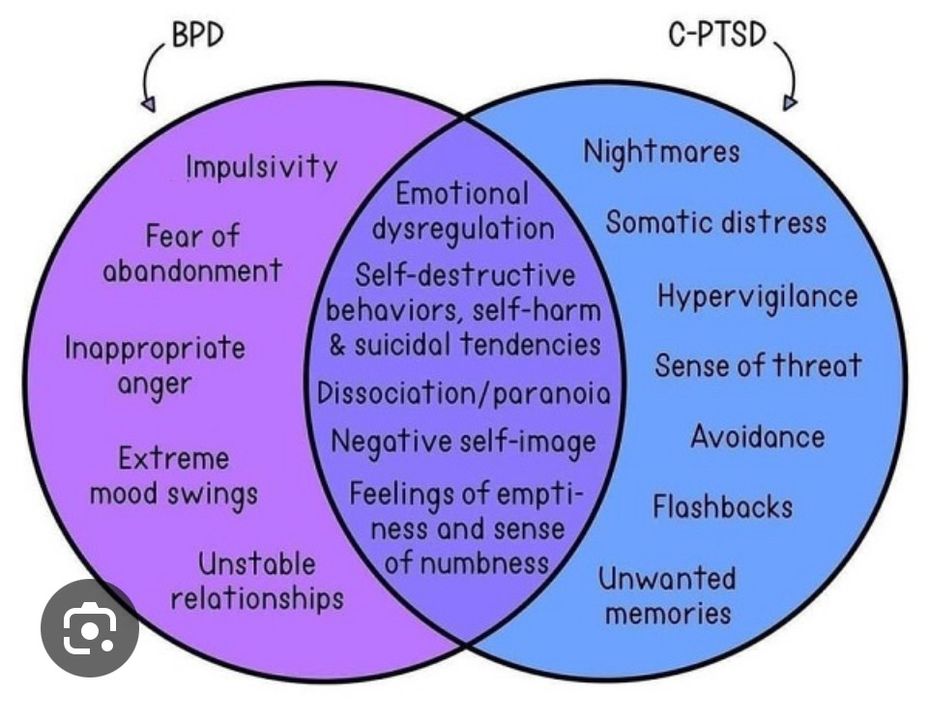
Recently, a new diagnosis has emerged, CPTSD, Complex Post Traumatic Stress Disorder. This disorder shares many symptoms with BPD, and is different from PTSD in that it relates to damage from long-term trauma and not one singular traumatic event or experience. I discovered this new diagnosis while researching trauma response in relationships. (It has been excluded from the DSM-5 thus far). There have been mixed feelings and opinions from the psychological community at large as to the significance of this new diagnosis, and some resistance due to the symptom overlap between CPTSD and other disorders. One of the biggest areas of contention has been the overlap between CPTSD and BPD. In the image I shared, the overlap in symptoms can be seen.

I wanted to reach out to the community here, and ask for thoughts regarding the overlap between BPD and CPTSD, and also ask for advice in the way of overcoming long-term trauma. What are your thoughts on CPTSD, and how should it be interpreted by those who have received a BPD diagnosis? What methods of treatment or small actions have been helpful for you (or your patients) as it relates to trauma responses and being able to recognize them? Has anyone else struggled with long term trauma lasting multiple years, and adjusting to “normal” life on the other side?

I also wanted to ask for thought and feedback regarding unprocessed trauma, and how processing past trauma in a healthy way might have helped you (or a patient)? What steps were taken to process the trauma? What connections were established or discovered between the trauma and behavioral responses to triggers? How were these responses redirected or altered, thus diminishing the “trauma realm” response and shifting to a more mindful and present(in the now)-focused response?

All thoughts and feedback is appreciated!

(edited)
Most common user reactionsMost common user reactions 17 reactions 4 comments
Post

Advice on moving forward from an online connection? *PLEASE READ :)

This happened about 3 years ago now. The peak of Covid. I was going through a media craze and experienced so much toxic behavior from people I’ve spoken to. Suddenly I talk to this great guy from the UK and while things were going pretty fine, I was still so overcome and traumatized from other connections and even more so with a particular guy from Ohio ( I was emotionally manipulated and also love bombed *yikes*) and to put it lightly I’m a very deep emotional person, so I was going through deep waters. I just had a random urge to squash the relationship by insulting his looks and saying crazy obscene things to the point of him being completely offended and ‘shouting’ obscenities towards me in defense. But I guess I deserved it. He ended up blocking me with much hesitation though I tried apologizing and he wouldn’t buy it. With needless to say, that was our end. But now I realize that he was the only one who actually cared and wanted to get to know me deep down. And I find myself missing him and our. I messed up. It’s an awful feeling. I gave up the apps as a whole but now it feels like I’m waiting for a connection that might never come. But I still have hope. #MentalHealth #checkin #Depression #Anxiety #Relationships #Opinion #ADHD #Guilt #BorderlinePersonalityDisorder #OCDTest #SuicidalThoughts #selfsabotage #lowselfesteem #SleepDisorders #Insomnia #moodswings #PMS #ChronicFatigue #Hope

Most common user reactionsMost common user reactions 4 reactions 1 comment
Post

Moving on from a self sabotaged relationship

Has anyone ever had a great connection with a genuine person but let their own insecurities and trauma get the best of you, and now they’re gone and you can’t reach out? How can you move on?
#checkin #BorderlinePersonalityDisorder
#ComplexPosttraumaticStressDisorder #Depression #SeparationAnxiety #selfsabotage #OnlineDating #Relationships
#tired #CPTSD #self -sabotage #Dating #Love #stuck

Most common user reactionsMost common user reactionsMost common user reactions 19 reactions 5 comments